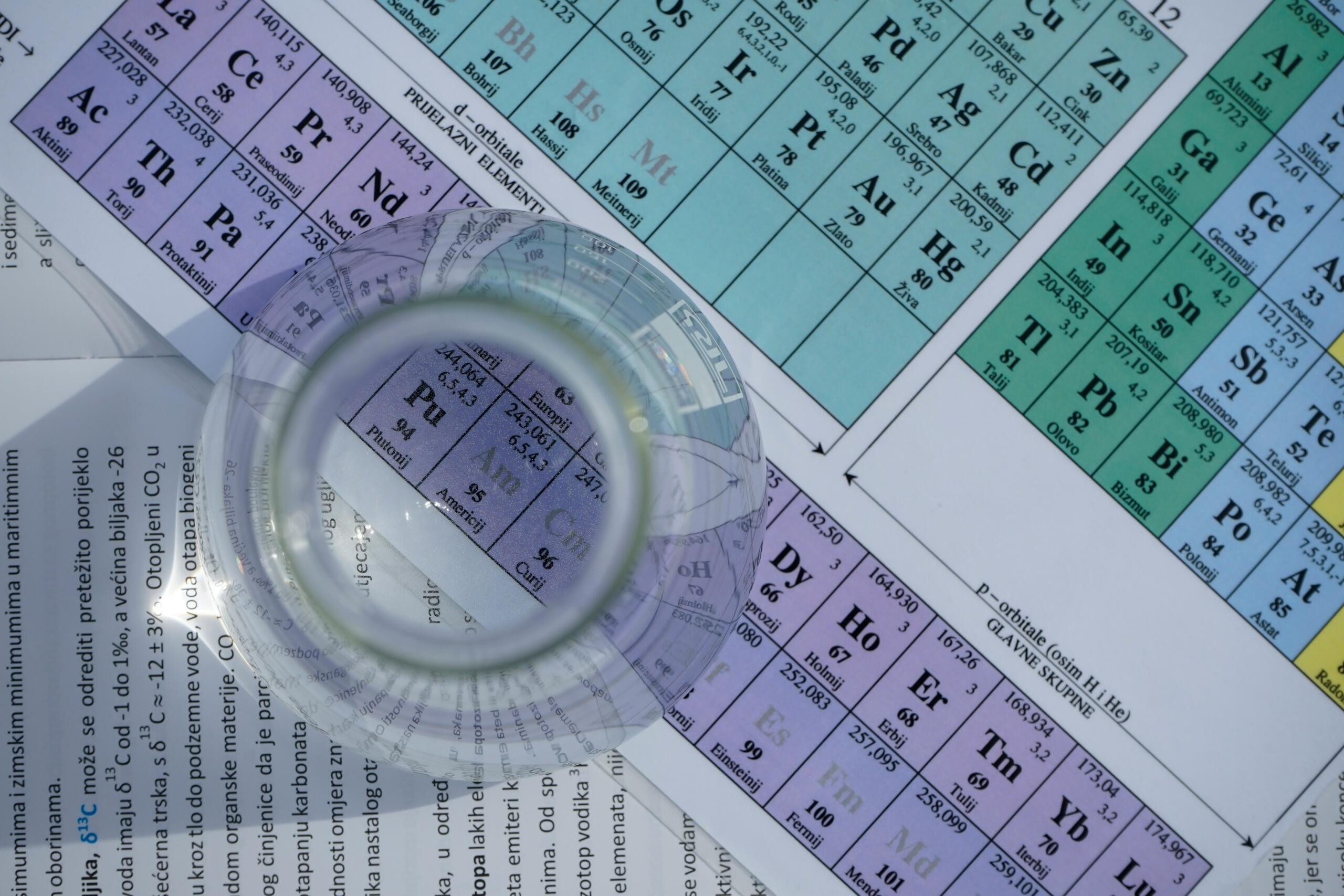

The periodic table of elements may sound like something that only interests chemists, but in fact, this unique system contains a treasure trove of knowledge about the building blocks of our world! From the atoms that make up air and water to the more complex elements that play a role in technology, each element has its own story to tell.
This quiz is your chance to test your knowledge of the periodic table and find out how well you know the different elements. Whether you had to memorise the periodic table in school or you're just curious, it's time to put your knowledge to the test!
Quizzes
Quizzes :


The Periodic Table of Elements
The periodic table contains more than 100 known elements according to their atomic number and chemical properties. It helps us understand the structure of matter and shows us the relationships and interactions of the elements in nature. Each of these elements is a fundamental building block that shapes the world around us - be it oxygen, which allows us to breathe, or gold, which has been used for cultural and economic purposes for centuries.
The principle of periodicity states that the chemical properties of elements repeat themselves regularly when they are arranged by atomic number. Elements in the same group have similar properties because they have the same number of electrons in the outer shell.
With the discovery of the principle of periodicity in 1869, Dmitri Mendeleev laid the foundation for many scientific advances. Since then, the periodic table has been continuously expanded as new elements are constantly being discovered or created artificially.
Each element has a unique symbol and atomic number – from “H” for hydrogen to “Og” for Oganesson.
The Structure of the Periodic Table
The periodic table is more than just a table: it is a tool that helps us organise and understand the diversity of chemical elements. The elements are divided into periods (horizontal rows) and groups (vertical columns) according to their atomic number (the number of protons in the atomic nucleus) and their chemical properties.
The different groups of the periodic table include:
- Alkali metals (group 1) – very reactive, and do not occur in pure form in nature.
- Alkaline earth metals (Group 2) – less reactive than alkali metals, but still relatively reactive.
- Halogens (Group 17) – very reactive non-metals that often form salts with metals.
- Noble gases (group 18) – colourless, odourless, very stable, rarely react with other elements due to their full electron shell.
- Transition metals (groups 3-12) – metals with many practical applications that often act as catalysts.
- Lanthanides (14th-period series) – often referred to as rare earth metals, play a role in electronics and catalysis.
- Actinides (15th-period series) – the series also contains radioactive elements such as uranium and plutonium.
These groupings make the periodic table a powerful tool for chemists and researchers around the world, as they enable predictions about how elements react.
The Use of the Periodic Table in Everyday Life
The periodic table is not only important for chemists but also for technological and industrial development. Many of the materials that shape our everyday lives - from electronics to medicine - are based on elements and their unique properties.
For example, most metals used in industry consist of elements such as iron (Fe) or copper (Cu), whose chemical properties are important for the production of alloys and electronics. But important elements are also found in the environment: carbon (C) in the air, hydrogen (H) in water and oxygen (O) in our atmosphere are all components of life.
The Periodic Table as a Key to the World of Chemistry
The periodic table is much more than a simple table - it's a complex yet accessible system that helps us understand the structure of matter. From the basic atoms to the latest synthetic elements, it's a map that shows us how everything around us is built. Mastering the periodic table will allow you to see the world from a whole new perspective and discover how the many elements are connected in nature and technology.
The periodic table also remains a lively field of research: new elements are discovered, knowledge of their chemical properties deepens, and applications for science and technology grow steadily. There is still much to learn and discover.
Have fun with the quiz and good luck – maybe you will be the next elementary genius!
Summarise with AI:
Enjoyed this article? Leave a rating!

 Loading...