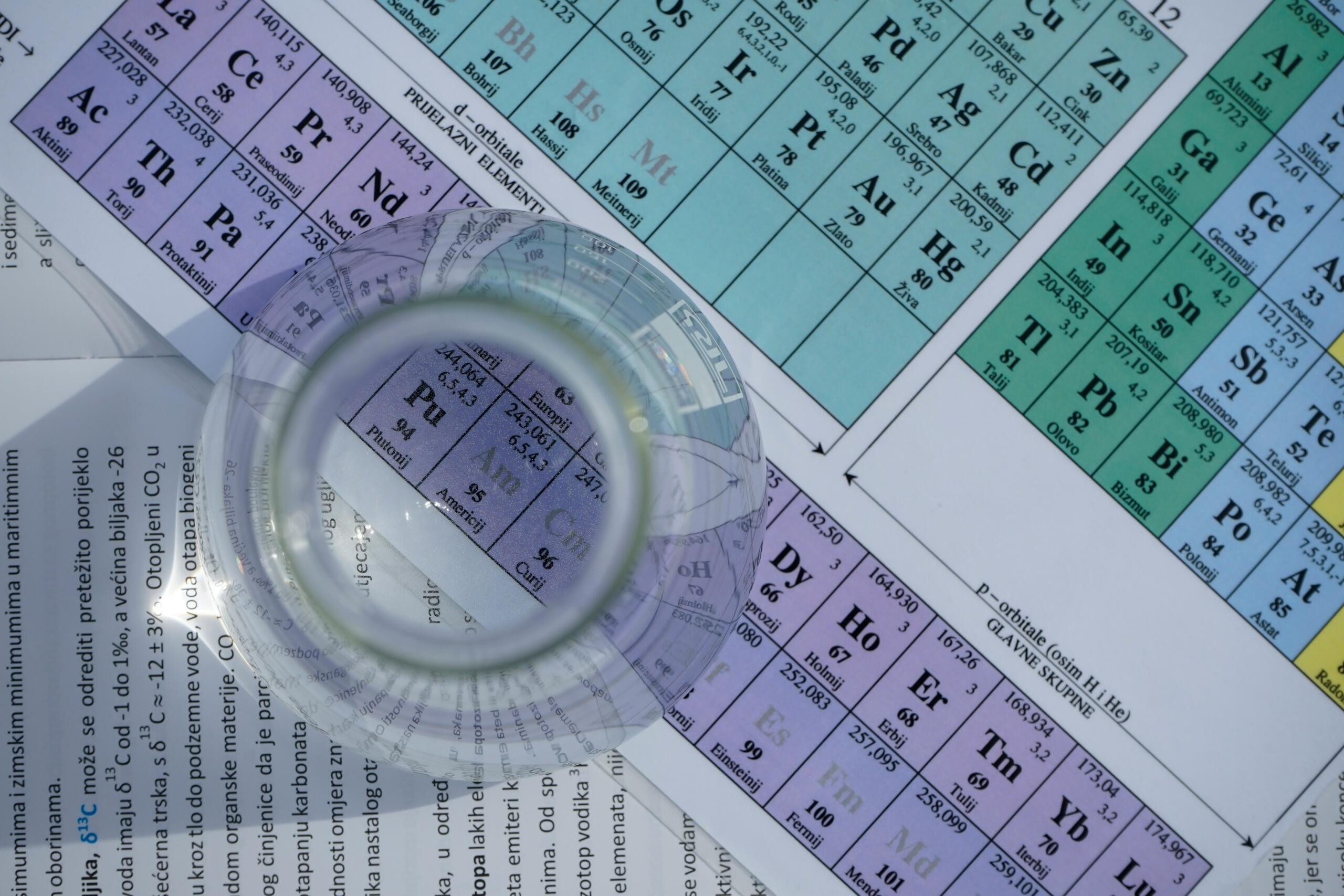

Our high school chemistry quiz is designed to test your understanding of the fundamental chemistry concepts that are typically covered in the South African high school curriculum.
From protons and atoms to chemical reactions and the periodic table, our quiz will test your knowledge and assess your comprehension of the building blocks of matter and the interactions that govern the world we live in.
Get ready to explore the fascinating world of chemistry and see how much you know about the different chemical elements and how they behave!
Ready to start the quiz?
Quizzes
Quizzes :


🧪 High School Chemistry Topics
While Grade 10 to 12 chemistry will cover a wide range of topics, here's an overview of some of the most important topics that you'll need to master for the final exam:
- Organic chemistry: In the senior grades, organic chemistry focuses on the study of carbon-containing compounds, particularly hydrocarbons and their derivatives. You'll learn about various functional groups (such as alcohols, aldehydes, ketones, and carboxylic acids), reaction mechanisms (including nucleophilic substitution and electrophilic addition), and the synthesis and properties of organic molecules.
- Atomic structure: This involves understanding the arrangement and behaviour of subatomic particles within an atom. You'll study electron configurations, energy levels, and orbitals, as well as concepts like ionisation energy and atomic spectra.
- Energetics: In the senior years of high school, this will cover the study of energy changes during chemical reactions, focusing on enthalpy changes (ΔH).
- Bonding: You will delve into the different types of chemical bonds that hold atoms together in compounds. You'll examine covalent, ionic, and metallic bonds, as well as intermolecular forces like hydrogen bonding, Van der Waals forces, and dipole-dipole interactions.
📝 5 Top Tips for Acing Matric Chemistry
- Understand the Basics:
- Ensure you have a solid grasp of basic concepts such as atomic structure, bonding, and stoichiometry. These foundations are crucial for tackling more complex topics.
- Use Multiple Resources:
- Utilize textbooks, online resources, videos, and study guides to get different perspectives and explanations. Sometimes, a different resource can make a difficult concept click.
- Create a Study Schedule:
- Plan your study time effectively. Break down the syllabus into manageable chunks and allocate specific times to focus on each area. Regular, scheduled study sessions are more effective than cramming.
- Focus on Problem Areas:
- Identify topics you find challenging and spend extra time on them. Don’t avoid difficult areas; facing them head-on will improve your overall understanding.
- Make Summary Notes:
- Condense your notes into key points, equations, and definitions. Use diagrams and charts where possible to visualise information. This will make revision quicker and more efficient.
Summarise with AI:
Enjoyed this article? Leave a rating!


 Loading...