

The English language is full of wonderfully weird words like the guttural-sounding 'girl', whose origins are unknown. The term 'discombobulate' (to upset or embarrass) is a 19th-century Americanism that wants to come from Latin but doesn't quite make it. So, be assured, there must be so many English words you didn't know. It's hard to say how many, but here, we study a passel (a group) of them.
| 😍Word | 🔎What it means | 📍Where it comes from | 🔊Sample sentence |
|---|---|---|---|
| Facetiously | Not seriously, mockingly | 1590s French | |
| Syzygy | At least 3 planets in a straight line. | 1650s Latin, from Greek | |
| Queue | A line of people or cars that are waiting for something. | 1500s French | |
| Newfangled | Something new or novel | 1350s Germanic roots | |
| Gardyloo | A warning ahead of tossing dirty water out the window. | mid-1700s, from Scotland | |
| Snickersnee | Fight with knives | 1600s, possibly from Dutch | |
| Widdershins | Against the way; in the opposite direction | early 1500s, from Scotland | |
| Flibbertigibbet | A chattery, gossipy person | mid-1500s, Middle English | |
| Pandiculation | The morning's first stretch | 1600s, from Latin | |
| Quire | 24 sheets of paper | 1200s, from French cahier! | |
| Ratoon | a shoot that grows next to the root or crown of a crop plant | 1700s, from Spanish | |
| Borborygmus | A rumbling in the bowels | 1600s, from Latin | |
| Brouhaha | an uproar; an angry scene | 1400s, from Fench | |
| Absquatulate | to leave suddenly, run away | mid-1800s, American | |
| Donnybrook | riotous disorder | 1850s, from English Donnybrook Fair, County Dublin | |


Facetiously
This common adverb is probably among the English words you didn't know because it is quite remarkable. It is the only word in the English language that features all the vowels in their proper order. It even includes 'Y' because, you know, sometimes 'Y', but you could do away with it by leaving the '-ly' off.
🏆'Facetiously' ranks at the top of this wordsmith's list of favourite words.🏆
Syzygy
It's the only word in the English language that features three 'Y's, and also the only one to consist of only consonants. The table above specifies that this noun describes three planets in a row. However, the definition has been expanded to include anything unusual that appears as three in a straight line.
For instance, one of my students has three beauty marks across her face. They trace a straight line from the corner of her right eye to the middle of her left cheek, giving her a syzygial (adj.) appearance.
Queue
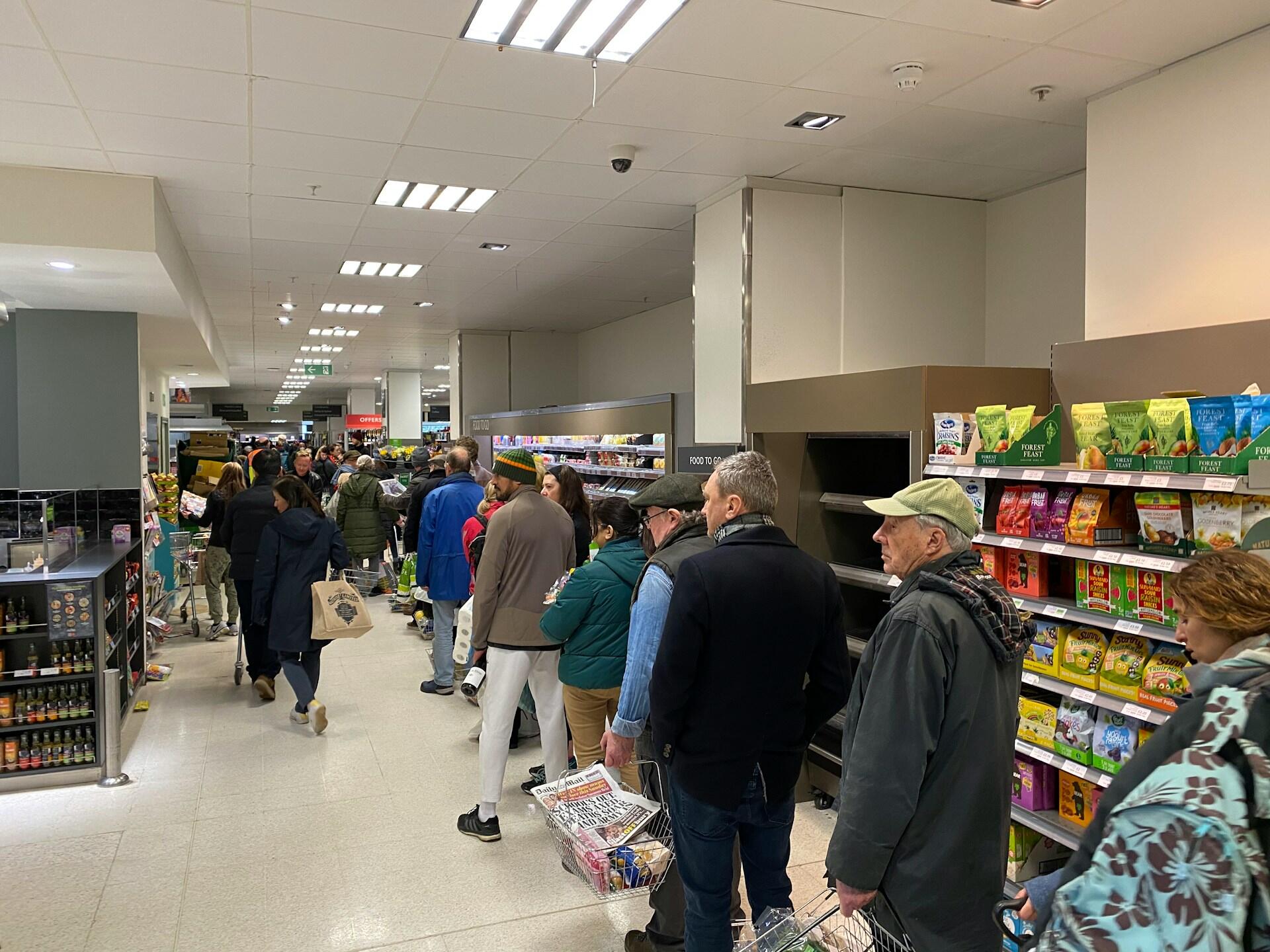
Who doesn't know what a queue is? And woe betide the one who jumps the queue! In French, this word means 'tail', an apt description of long queues of people waiting for something.
We only pronounce the letter Q; the last four letters serve no purpose.
At least, in English they don't (in French, they're vitally important!). The English language is full of silent letters and repetitions (like 'ueue' in 'queue') that make learning how to speak English a challenge.
Newfangled
This adjective has one of our list's longest histories. It entered the German language around the 13th century and the root verb, fangen, is still in use today. This is probably another one of those English words you didn't know because it has no opposite: there's no such thing as an oldfangled thing.
Gardyloo
This noun has a colourful, if disgusting, history. Before plumbing, people routinely threw their chamberpots' contents out of the window. Not just chamberpot contents, but bathwater, washing water... Any type of liquid is no longer welcome in the house. So, if you are asking how old is English language - well, it is older than modern abblutions!
In French, the phrase is garde a l'eau! - 'Look out for the water!'
Before chucking their buckets' contents, the house occupant would shout this word to warn passersby of something foul on its way out.
Snickersnee
Far from its endearing sound, this noun represents a threat.

It comes to us from Germanic languages, nations famous for sword and knife fights. In fact, that's just what this word means: fighting with knives. It's actually a compound word whose translation roughly means 'stick and cut'.
Today's Brits occasionally use 'snee' instead of 'cut', a throwback to older forms of English - maybe they trying to be the answer to that question - who invented English language!
Widdershins
Going against the grain is a standard Scottish trait, but that doesn't mean this word is wholly Scottish. It's likely that this adverb is another German import, rather than an original Scottish creation - delightful as they always are. How can we tell?
German
wider = against
sinnen = sense
English
widder - widow (American slang)
shins = lower leg
As this word means 'contrary to the usual', it's a safe bet that the German theory holds.
Flibbertigibbet
If your mate is scatterbrained, irresponsible, or silly in every measure, you might say they are flibbertigibbety. The adjective form of this word has a nice ring to it, but it is a mouthful!
Most academics agree that 'flibbertigibbet' is a Middle English creation. But some contend that Old Scandinavians used it first. The argument has merit; the Old Norse word is fleipra-geipa, meaning 'blabberer of nonsense'.

Pandiculation
Have you ever woken up from a particularly good sleep and, before even getting up, you do a whole body stretch? If so, congratulations: you have pandiculated!
🐈Cats are famous for their full-body stretches.🐈
If you're a cat lover, you may have already concluded your stretches put in good company. However, the practice goes far back into history. The word comes to us from Latin (pandiculari - to stretch oneself). Just picture the scene after a long Roman Senate session!
Quire
Dating to around 1200, this intriguing noun is among the oldest on our list. French speakers will likely experience an "A-HA!" moment when they learn its roots.
'Quire's original spelling and pronunciation was 'quaier', an exact phonetic double to the modern French word for notebook: cahier.
French speakers, be not proud! This word goes further back, to the Latin word quaternus, meaning 'four each' of something.
Xertz
Not so long ago, parents would tell their children not to gulp their food and chug their milk, lest it upset their tummies. Unfortunately, today's fast-paced world has turned us all into xertzers.
"Hold on! I'ma xertz my sarnie while I get my shoes on!"
You might utter such a sentence to your mates as they try to rush you out the door. Conversely, you might catch yourself xertzing your fizzy drink before walking through airport security, as they don't allow drinks through. Of all the English words you didn't know, 'xertz' is among the most useful, and the most fun.

Borborygmus
It's rather unfortunate that we say 'my tummy's grumbling' - borborygmus' definition, instead of this marvellous word. Like many other English words you didn't know, it comes to us from Latin, but it has Greek roots.
Do you have a borborygmic stomach? You might feel borborygmal if you eat something that doesn't agree with you. In either case, make sure you're never too far from the loo!
Brouhaha
Did you know that approximately 27% of all English words have their roots in French? This noun is a delightful example of such. It dates to the 1400s, a time when France was full of angry confusion.
The online etymology dictionary suggests that this word originated in medieval theatre.
It was the noise the devil-character made while dressed as clergy.
Anyone with a mildly vivid imagination can paint that scene: a malignant being dressed in robes, ominously shouting "BROU-AH-AH!" from stage left. However, a more academic origin exists, related to the Hebrew barukh habba, which means 'blessed is the one who comes'. That's a far cry from 'riot', 'melée', and 'uproar', though.
Absquatulate
This 19th-century Americanism is meant to sound like it came from Latin and perhaps there's a grain of truth to that. We know that 'to squat' means to stay put, and the 'ab' prefix means 'away from' or 'opposite to', both of which have Latin roots.
Absquatulate = abscond + squat + perambulate
Admittedly, it's far easier for the police to tell people to get moving than to say: "Get to absquatulating now!" We bet this one is among English words you didn't know, and is well worth its place on our list. It's not even that hard to pronounce; in fact, it's kind of fun!
Donnybrook
Is it unfortunate that so many weird words in English involve some kind of fighting? Or does that just tell on us about the culture we evolved from?
Donnybrook, Dublin, gave civilisation many cultural treasures: the jig, ballads... And a slang term for brawling. Donnybrook Fair, held annually from the 12th to the mid-18th century, often featured disorder and chaos.
It's hard to tell whether it betrayed underlying tensions or it was all in good fun.

Nudiustertian
Strange words aside, the English language is famous for its shortcuts and relatively easy grammar. But sometimes, it misses that mark. Nudiustertian hopes to replace the clunky phrase 'the day before yesterday', which is a prime example a phrase needing a shortcut.
At least 20 languages have a word that means 'the day before yesterday'.
English speakers used to say 'ereyesterday' but nobody uses that word anymore. Today, Collins Dictionary is reviewing a petition to make nudiustertian mainstream.
Pauciloquent
This word is right up the pauciloquent's alley. A single word to describe a person who uses words sparingly. It combines 'paucity' with 'eloquent'.
A pauciloquent person is less likely to mispronounce words because they choose their words carefully. To honour the pauciloquent among us, here endeth this entry.
Highfalutin
Caution: you might be accused of highfalutinism if you use some of the words on this list. Fancy talkers are typically accused of arrogance and pomposity, hallmarks of being highfalutin.
This adjective emerged in 1800s America. Scholars believe it might have come from 'high-fluting' or 'high-flying'. It's generally meant as an insult but it can sometimes be a compliment: "That's some highfalutin living you have going on!".
Nincompoop
For those who debate who invented English language, or indeed, how old is English language, this silly-sounding noun has a surprisingly long history. It first appeared in writing around the 1670s to describe a man unusually dependent on his wife (a uxorious fellow). Some linguists believe it might have a religious connection: Nicodemus, who asked Jesus naive questions.
In French, the now-obsolete word 'nicodème' roughly meant Simple Simon.
The Dictionary of the Canting Crew, the slang dictionary of the late 1600s, defined 'nincompoop' as a fool. The most interesting part of that sentence is that even in the 1600s, slang dictionaries were a thing.
Bloviate
Does every family have that one member who insists on nonstop chatter, usually about nothing? If yours does, congratulations! You have a bloviator in your midst. You also know one of the strangest words in the English language.
'blow' + 'deviate'
In other words, someone who blows hot air while deviating from their topic.
This once-obscure Americanism might have remained local were it not for John Stephen Farmer, the British lexicographer. He heard it (in 1890), fell in love with it, and made it popular.
Comeuppance
To understand why this word is so weird, we have to look at the action it suggests. Back in the day, to 'come up' meant 'come up to the judge's bench so you can be held accountable'. With this explanation, you can see how come + up + -ance means punishment.
Zoanthropy
Wtih Halloween just around the corner, zoanthropes around the world are gearing up for their big night.

Except we all know that All Hallow's Eve is just for fun. Those afflicted with zoanthropy battle a genuine psychological condition that makes them believe they are part animal. Where such notions come from is beyond this article's scope. The word 'zoanthropy' come from Latin via French.
Bibble
Only the strictist self-denier (ascetic) could claim they take no pleasure from food. However, we could all agree that someone who enjoys their food so much that they make loud noises while they eat or drink is beyond the pale.
People with misphonia experience anger and disgust when they hear people bibble.
For some, the disgust is so strong they feel the urge to flee!
The etymology dictionaries gave no clue where 'bibble' comes from or when it emerged. But, it's no stretch to imagine this word as a slang term for inbibing. "How 'bout a little bibble to end the night on a high note, yeah?"
Wabbit
Earlier, you read that Scottish vocabulary is delightful; this is a sample from that treasure trove. It has nothing to do with bunnies and everything to do with being exhausted. Much as we'd like to, we have no way of telling when and how this gem of a term came about.
Hello Scottish readers: how about letting us in on what you know?
Snollygoster
Calling somebody unsavoury, shrewd, or unethical simply doesn't have the same punch as labelling them a snollygoster. In fact, it's a one-two punch of insult and etymology.
This noun comes from German:
schnelle = quick
Geiste = ghosts
Of course, the ghosts in question are of the malicious variety. Otherwise, one might take this word as a synonym for quick-spirited, a compliment far from the cursing snollygosters deserve.
You'd be hard-pressed to find any English-language homophones to partner this noun with. At best, the American household brand Oster comes to mind. That's not very helpful to us Brits, though.
Algebra
Did you know that some of the most familiar words in English actually began life in Arabic? Many English words of Arabic origin entered the language during the Middle Ages, when scholars translated Arabic works on mathematics, astronomy, medicine and philosophy into Latin and, eventually, English.
The Arabic language has contributed hundreds of words to English through trade, science and exploration.
Without Arabic, we might not have words like algebra, coffee, sugar, cotton or even magazine!
Take the word algebra, for example. It comes from the Arabic al-jabr, meaning "the reunion of broken parts". The mathematical term travelled from Arabic scholars into Europe, where it became one of the foundations of modern mathematics.
English Arrived: Then South Africans Made It Their Own
We've explored who invented English language and how it evolved over centuries, but the story doesn't end there. English has continued to grow wherever it has travelled, and South Africa has added its own unmistakable flavour.
One of the reasons English feels so rich is that it constantly borrows from other languages. Just as there are many English words of Arabic origin—such as coffee, sugar and magazine—South African English has happily adopted words from Afrikaans and several indigenous African languages.
Some of our best-loved expressions would leave visitors scratching their heads!
| South African Word | What it Means | Where it Came From |
|---|---|---|
| Robot | Traffic light | South African English |
| Bakkie | Pick up truck | Afrikaans |
| Braai | Barbecue | Afrikaans |
| Lekker | Great, enjoyable, excellent | Afrikaans |
| Howzit | Hello, how are you? | South African English |
| Now-now | Soon, but not immediately | South African English |
| Shame | An expression of sympathy, affection or admiration, depending on the situation | South African English |
South Africans also tend to swap formal English for friendlier local expressions. Someone might say, "Let's have a braai," instead of "Let's barbecue," or tell you a meal was "lekker" instead of simply saying it was delicious. Ask for directions and you could easily hear, "Turn left at the robot," rather than "traffic lights."
These uniquely South African words remind us that languages never stand still. If you've ever wondered how old is English language, the answer is around 1,500 years—but it's still evolving today. Every generation, and every country where English is spoken, adds something new to its vocabulary. South African English is proof that a language can honour its history while developing a personality all of its own.
Every Word Has a Story
The next time you hear someone say "Howzit?" or invite you to a braai, remember: you're listening to the latest chapter in a language that's been evolving for more than a millennium. That's what makes English such an endlessly fascinating language to learn.
Summarise with AI:
Enjoyed this article? Leave a rating!

 Loading...