

The FIFA World Cup is headed to North America this winter, and with South Africa qualified and a record-breaking 48 teams competing across three countries, there has never been a better time to be a soccer fan. From late-night kick-offs to fan zones up and down the country, here is everything you need to know about the 2026 FIFA World Cup.
Dates: 11 June - 19 July
The world's biggest sporting event will unfold across 16 cities in:
🇲🇽 Mexico
🇨🇦 Canada
🇺🇸 United States
This isn't just any World Cup. The 2026 edition is the largest ever staged:
- 🧑🏻🤝🧑🏻 48 nations competing
- 🏟️ 104 matches across 39 days
- 🌎 3 host countries
- ⏱️ 4 time zones
- Final: 19 July 2026 – MetLife Stadium, New Jersey (kick-off 21:00 South African Standard Time)
- 🤖 AI-powered technology
This will change how the game is officiated, analysed, and watched. Whether you're a lifelong football fan or discovering the sport for the first time, there has never been a better moment to get into the famous joga bonito.


Why the 2026 FIFA World Cup Is Unlike Any Before It
The 2026 FIFA World Cup rewrites the record books in virtually every category. From the number of participating nations to the technology powering each match, this edition marks a turning point for the beautiful game on the world stage.
🏆 The Biggest World Cup Ever: 48 Teams, 104 Matches
For the first time since the format expanded to 32 teams in 1998, FIFA has reshaped the tournament structure. The 2026 edition welcomes 48 national teams. Here's how it looks in comparison to previous years:
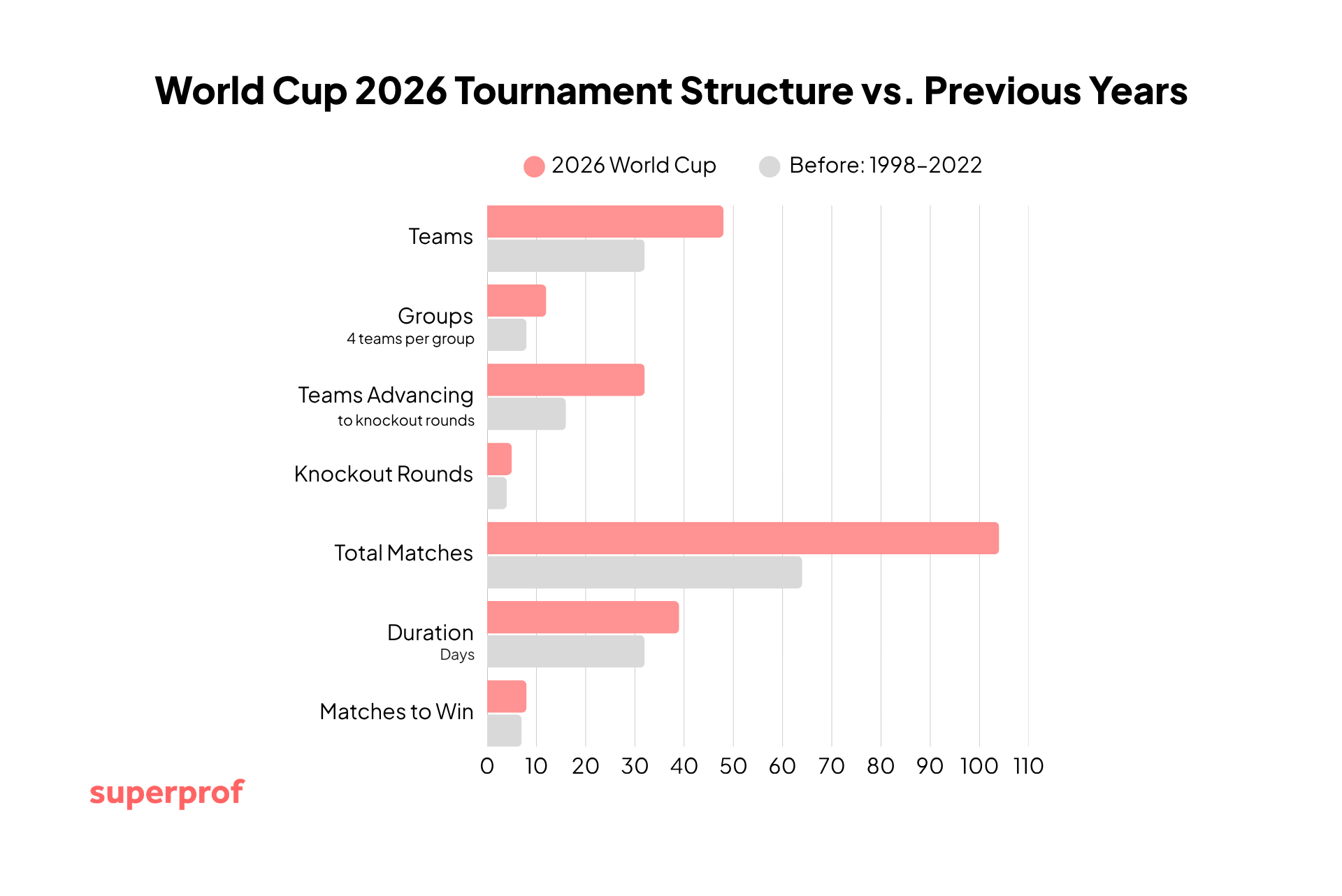
That expanded field translates to 104 matches over 39 days!
More games mean more football, more upsets, and more opportunities for emerging football-playing nations, particularly from Africa, Asia and CONCACAF (The Confederation of North, Central America and Caribbean Association Football), to make their mark on the global stage.
🌎 Three Host Nations, One Historic Tournament
Canada - in 2 cities
Mexico - in 3 cities
United States - in 11 cities
Mexico becomes the first country to host three separate World Cups, with Estadio Azteca in Mexico City having already staged the finals in 1970 and 1986. The tournament opener will be a battle between Bafana Bafana and Mexico.
Opening Match
🗓️ June 11
Location: Estadio Azteca
🇲🇽 Mexico City, Mexico
Capacity: 90 000
World Cup Final
🗓️ July 19
Location: MetLife
🇺🇸 New Jersey, USA
Capacity: 82 500
🗺️ A Tournament That Spans Four Time Zones
The sheer geographic scale of this World Cup is unprecedented. Matches will be played across four North American time zones, meaning SA fans can expect kick-off times ranging from late afternoon through to the early hours of the morning.
| Time Zone | UTC Offset | SAST Offset | Host Cities |
|---|---|---|---|
| Eastern (EDT) | UTC−4 | +6 hours | Toronto, New York/NJ, Philadelphia, Boston, Miami, Atlanta |
| Central (CDT) | UTC−5 | +7 hours | Dallas, Houston, Kansas City |
| Mountain (MDT) | UTC−6 | +8 hours | Mexico City, Guadalajara, Monterrey |
| Pacific (PDT) | UTC−7 | +9 hours | Vancouver, Seattle, Los Angeles, San Francisco |
In practical terms, a 15:00 EDT kick-off in New York is 21:00 South African Standard Time (SAST), while a 21:00 PDT game from Los Angeles is 06:00 SAST the following morning 🥱.
🤖 Cutting-Edge Technology: AI, 3D Avatars and Smarter Officiating
The 2026 World Cup is set to be the most technologically advanced edition in FIFA history, thanks in large part to a partnership between FIFA and Lenovo, the tournament's Official Technology Partner.
Advanced Semi-Automated Offside Technology (SAOT), which was first trialled at the FIFA Intercontinental Cup in Qatar in December 2025, has received a major upgrade. But, how does it work?
- All 1 248 players across the 48 squads will undergo digital body scans lasting roughly one second each, producing precise 3D models that capture exact body-part dimensions.
- These AI-enabled 3D avatars replace the generic stick-figure graphics of previous tournaments, allowing the system to track players more accurately during fast or obstructed movement.
The result? Faster, more precise offside calls are displayed in a way that's far easier for fans in the stadium and viewers at home to understand.
Enhanced VAR with Referee View builds on a system first tested at the inaugural FIFA Club World Cup in 2025. AI-powered stabilisation software smooths footage captured from a camera worn by the referee in real time, reducing the motion blur caused by rapid movement. The stabilised feed gives audiences a clearer first-person perspective of key decisions, increasing transparency around calls that have traditionally frustrated fans.
Football AI Pro, a generative-AI knowledge assistant, is another first. Built on FIFA's proprietary Football Language model and powered by Lenovo's AI infrastructure, it analyses hundreds of millions of data points to deliver insights via text, video, graphs, and 3D visualisations. All 48 teams will have access to the tool for pre-match and post-match analysis (though not during live play), helping level the playing field in an era where data-driven preparation can make the difference between group-stage elimination and a deep tournament run. The interface supports prompts in multiple languages and draws on millions of football data points generated per game
Host Countries and Stadiums
The 2026 FIFA World Cup is spread across 16 cities in three countries, making it the most geographically ambitious edition the tournament has ever seen. The United States hosts the lion's share with eleven venues, Mexico contributes three, and Canada welcomes the world to two. Here's where the action will unfold:
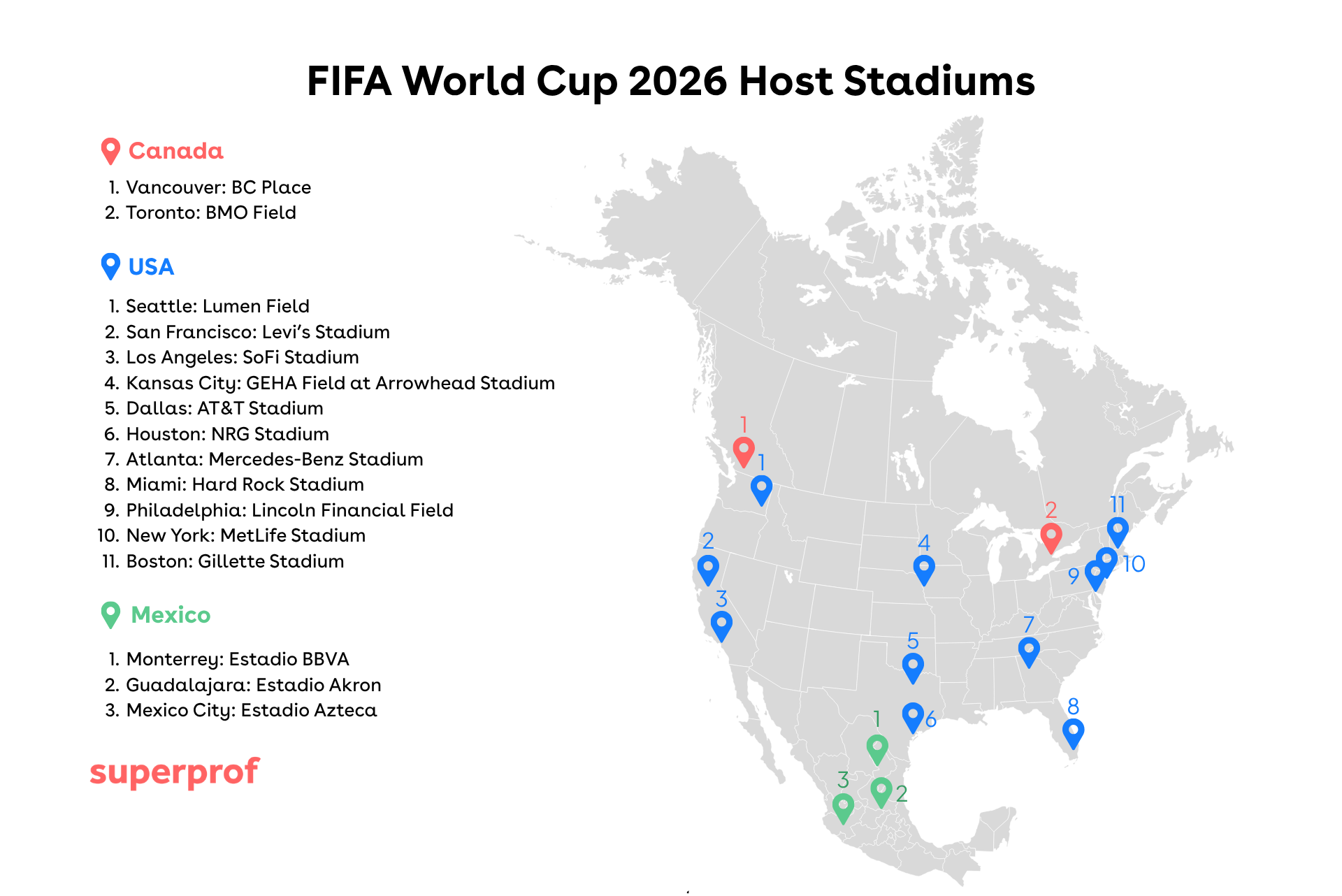
Each country brings its own football culture, infrastructure and atmosphere to the table, and together they offer a combined stadium capacity that dwarfs any previous World Cup.
Top 5 Stadiums by Match Count (2026 World Cup):
The Largest World Cup Ever: Here's How the New 48-Team Format Works
Starting with the 2026 tournament, the world's most famous football competition will expand significantly: instead of the previous 32 teams, the World Cup will now include a total of 48 national teams.
This change introduces a new competition format, giving more countries the opportunity to participate on football's biggest stage. But how exactly does this new system work?
Instead of eight groups of four teams, the new tournament splits the 48 teams into 12 groups of four teams. This means we will have a record of 72 group matches and a total of 104 matches. The new format also introduces a new Round of 32 to accommodate the increased number of teams advancing to the knockout stage. Here's how it looks:
Group stage (11 June — 27 June)
48 teams
Each group winner, group runner-up and the eight best third-place teams advance.
Round of 32 (28 June – 3 July)
32 teams
New stage introduced with the expansion to the format.
Round of 16 (4 July – 7 July)
16 teams
Historically, many famous World Cup upsets have happened in this round.
Quarter-finals (9 July – 11 July)
8 teams
Reaching the quarter-finals is already considered an achievement for most teams.
Semi-finals (14 July – 15 July)
4 teams
This stage decides who is going to compete for the World Cup final.
Third-place match 🥉 (18 July)
2 teams
Teams that lose in the semi-finals have a shot at redemption by competing for the 3rd place.
Final 🏆 (19 July)
Title match
The winner becomes World Champion and writes its name into football history.
How Does a Team Qualify for the Knockout Stage?
Here's how a team qualifies for the knockout stage at the 2026 World Cup:
The Group Stage
The group stage features 12 groups with 4 teams each. Every team plays three matches in a round-robin format. Teams earn three points for a win, one point for a draw, and zero for a loss.
Who Advances?
Qualification is primarily based on group rankings: the first-place team from each of the 12 groups automatically qualifies (12 teams total), the second-place team from each group also secures a spot (12 more teams), and the eight third-placed teams with the best overall records across all groups round out the field. That brings the total to 32 teams advancing to the knockout stage.
Tiebreakers
If teams are level on points, rankings are decided by: goal difference, goals scored, fair play points (based on yellow and red cards), and, if still tied, a drawing of lots. The same criteria are applied to rank third-placed teams and determine the eight best who advance.
The New Round of 32
The biggest change is the new Round of 32; no World Cup has ever featured this round before. Previous tournaments went straight from the group stage to the Round of 16, with only 16 teams advancing.
FIFA has chosen to place the four top-ranked nations in different brackets, guaranteeing that, if each of them advances as group winners, none of them will face one another before the semi-finals at the earliest.
The Knockout Path
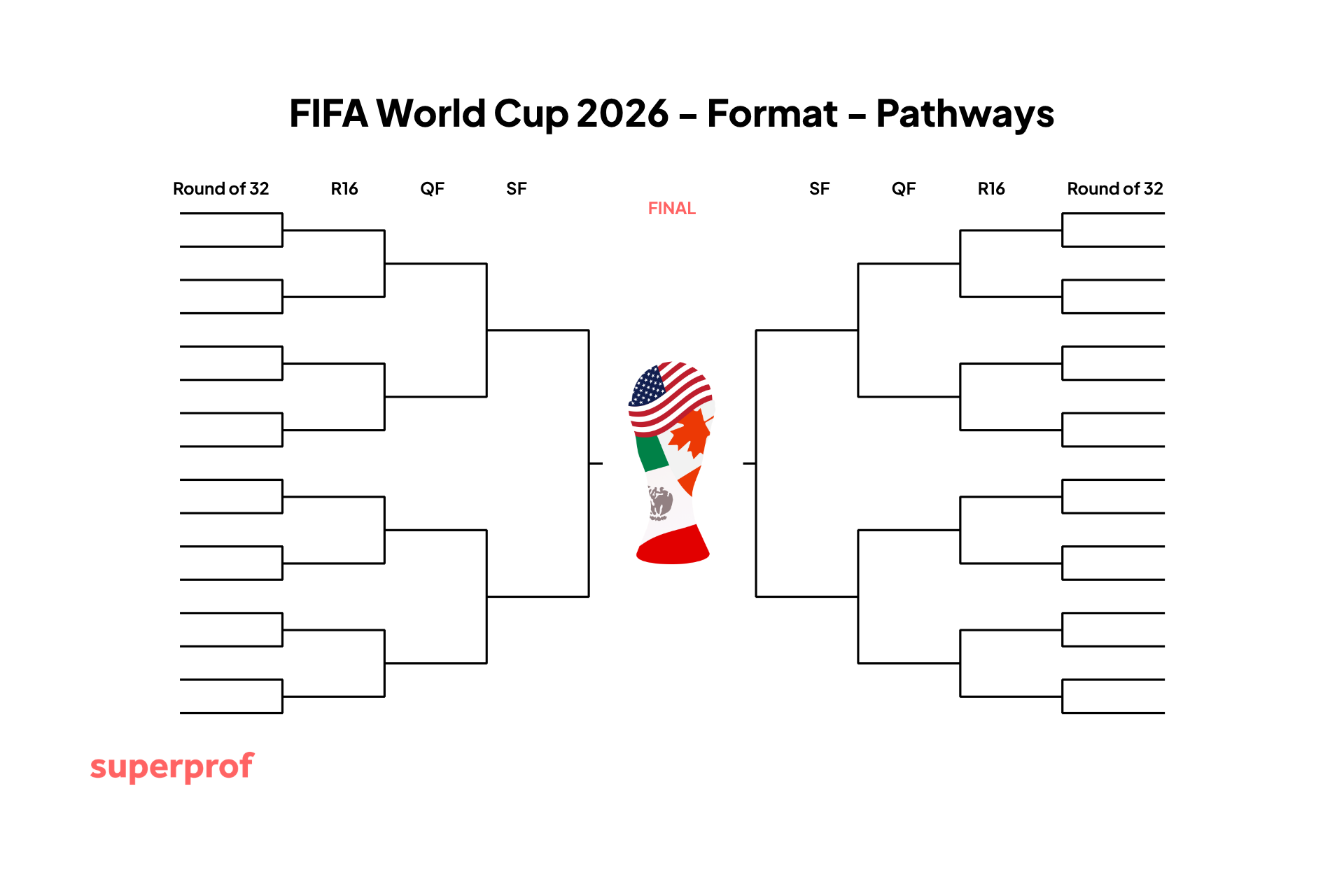
The 2026 champion will play eight matches in total, three in the group stage and five in the knockout rounds; one more than in any previous World Cup.
Here's a quick visualisation to help you understand:
Teams and Players to Watch: Full Calendar of Games Below!
The 2026 FIFA World Cup kicks off officially on 11 June in Mexico City, Mexico, with the home team playing against South Africa at the famous Azteca Stadium. Canada's first match is scheduled for the very next day, on 12 June, in Toronto, against a team coming out of the second round of the UEFA qualification.
The group stage matches will be played every day until 27 June. The Round of 32 will take place from 28 June to 3 July, followed by the Round of 16 matches from 4 to 7 July. The quarterfinals are scheduled for 9 to 11 July, and the semifinals will be played on 14 and 15 July. The third-place match will be held on 18 July, and the big final will take place on the following day, on 19 July in New Jersey, United States.
Here is a breakdown of the World Cup 2026 groups and group-stage matches, along with local kickoff times:
Group A
| Date | Match | Host City Time | SAST (SA) | Stadium |
|---|---|---|---|---|
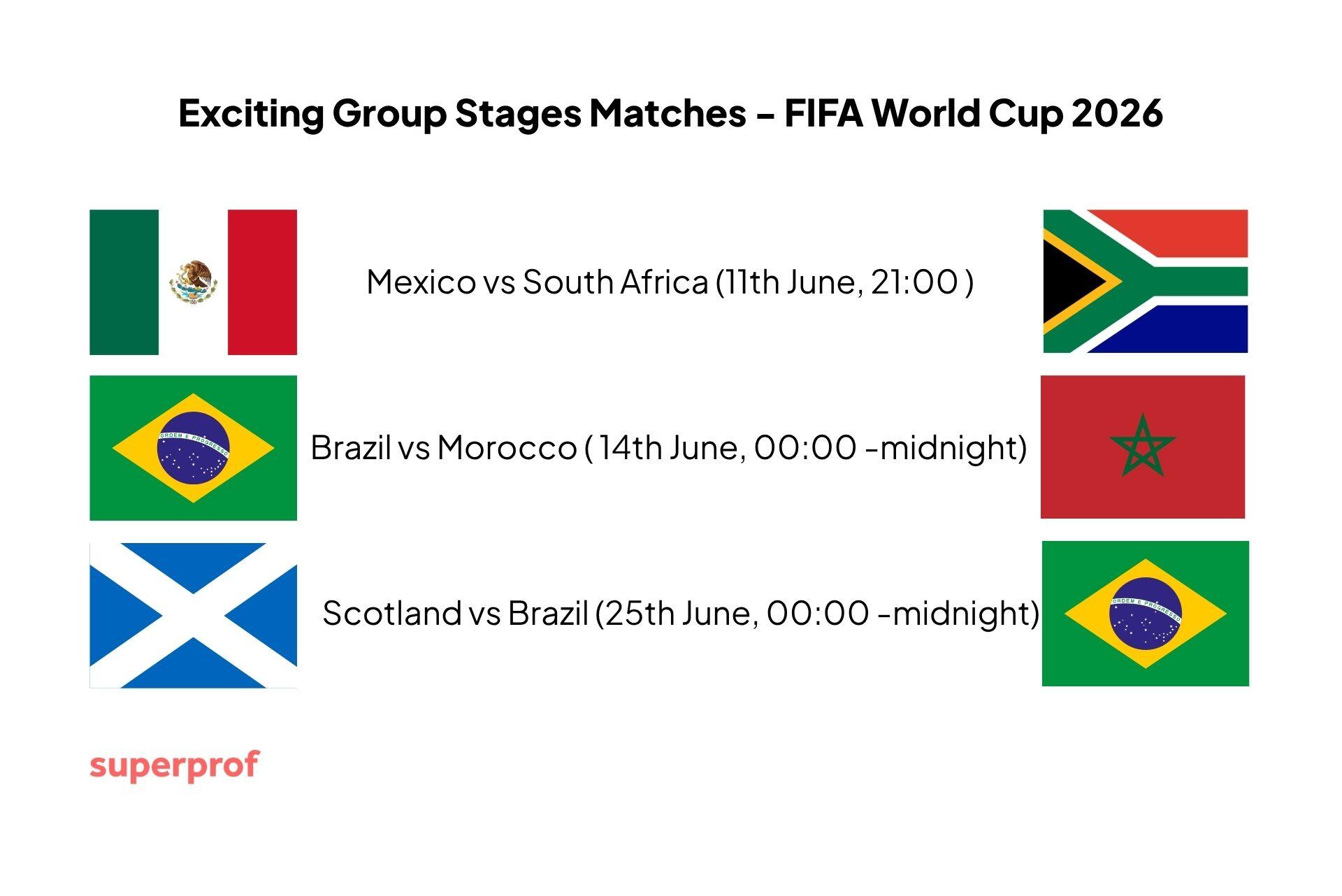
| 11 Jun | Mexico 🇲🇽 vs South Africa 🇿🇦 | 14:00 CDT | 21:00 | Estadio Azteca, Mexico City |
| 11 Jun | South Korea 🇰🇷 vs Czechia 🇨🇿 | 22:00 CST | 04:00 (12 Jun) | Estadio Guadalajara |
| 18 Jun | Czechia 🇨🇿 vs South Africa 🇿🇦 | 12:00 EDT | 18:00 | Mercedes-Benz Stadium, Atlanta |
| 18 Jun | Mexico 🇲🇽 vs South Korea 🇰🇷 | 21:00 CST | 03:00 (19 Jun) | Estadio Guadalajara |
| 24 Jun | Czechia 🇨🇿 vs Mexico 🇲🇽 | 20:00 CDT | 03:00 (25 Jun) | Estadio Azteca, Mexico City |
| 24 Jun | South Africa 🇿🇦 vs South Korea 🇰🇷 | 21:00 CDT | 03:00 (25 Jun) | Estadio BBVA, Monterrey |
Group B
| Date | Match | Host City Time | SAST (SA) | Stadium |
|---|---|---|---|---|
| 12 Jun | Canada 🇨🇦 vs Bosnia & Herzegovina 🇧🇦 | 15:00 EDT | 21:00 | BMO Field, Toronto |
| 13 Jun | Qatar 🇶🇦 vs Switzerland 🇨🇭 | 15:00 PDT | 21:00 | Levi's Stadium, San Francisco |
| 18 Jun | Switzerland 🇨🇭 vs Bosnia & Herzegovina 🇧🇦 | 15:00 PDT | 21:00 | SoFi Stadium, Los Angeles |
| 18 Jun | Canada 🇨🇦 vs Qatar 🇶🇦 | 18:00 PDT | 00:00 (19 Jun) | BC Place, Vancouver |
| 24 Jun | Switzerland 🇨🇭 vs Canada 🇨🇦 | 15:00 PDT | 21:00 | BC Place, Vancouver |
| 24 Jun | Bosnia & Herzegovina 🇧🇦 vs Qatar 🇶🇦 | 15:00 PDT | 21:00 | Lumen Field, Seattle |
Group C
| Date | Match | Host City Time | SAST (SA) | Stadium |
|---|---|---|---|---|
| 13 Jun | Brazil 🇧🇷 vs Morocco 🇲🇦 | 18:00 EDT | 00:00 (14 Jun) | MetLife Stadium, New Jersey |
| 13 Jun | Haiti 🇭🇹 vs Scotland 🏴 | 21:00 EDT | 03:00 (14 Jun) | Gillette Stadium, Boston |
| 19 Jun | Scotland 🏴 vs Morocco 🇲🇦 | 18:00 EDT | 00:00 (20 Jun) | Fenway Park Stadium, Boston |
| 19 Jun | Brazil 🇧🇷 vs Haiti 🇭🇹 | 21:00 EDT | 03:00 (20 Jun) | Lincoln Financial, Philadelphia |
| 24 Jun | Scotland 🏴 vs Brazil 🇧🇷 | 18:00 EDT | 00:00 (25 Jun) | Hard Rock Stadium, Miami |
| 24 Jun | Morocco 🇲🇦 vs Haiti 🇭🇹 | 18:00 EDT | 00:00 (25 Jun) | Mercedes-Benz Stadium, Atlanta |
Group D
| Date | Match | Host City Time | SAST (SA) | Stadium |
|---|---|---|---|---|
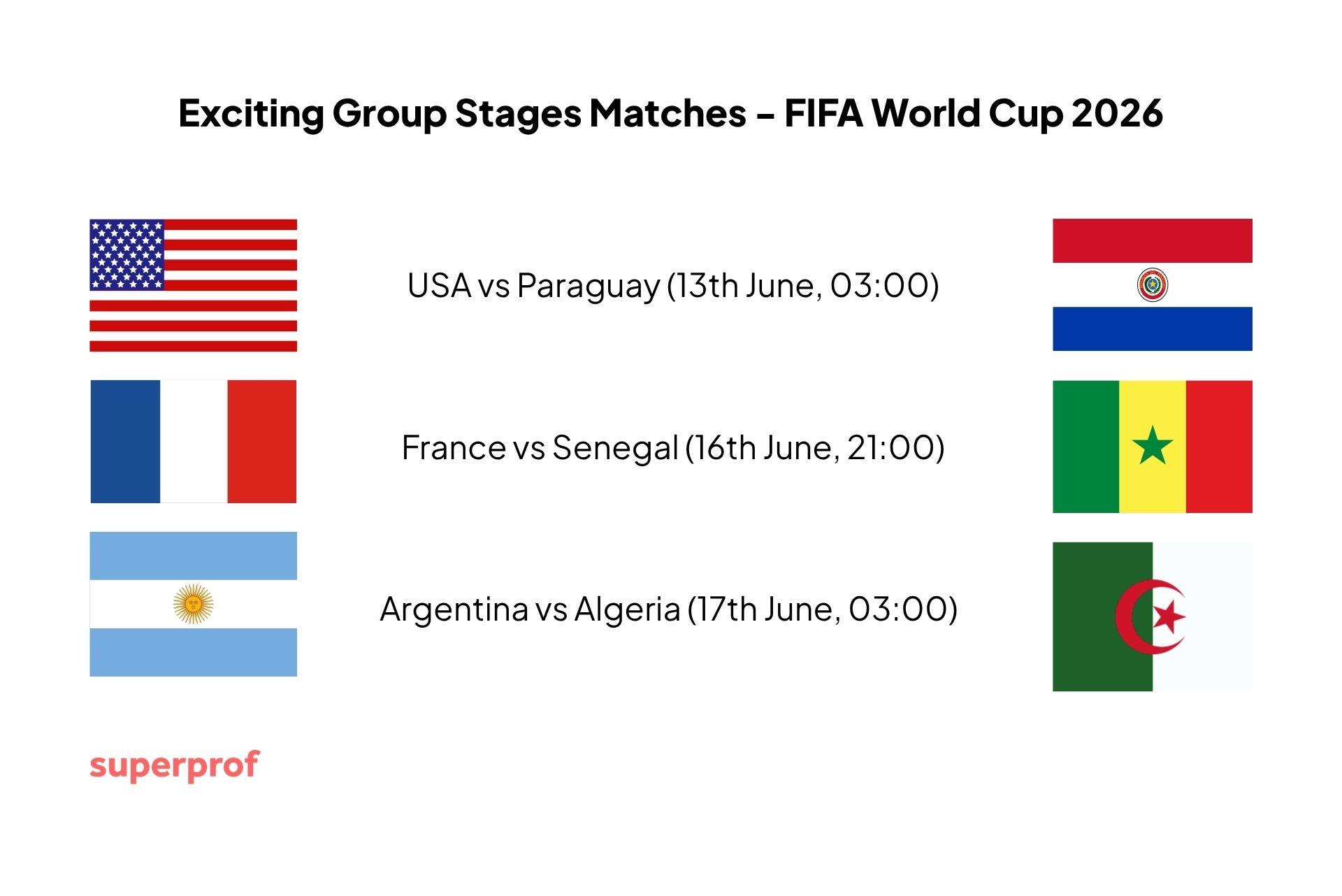
| 12 Jun | USA 🇺🇸 vs Paraguay 🇵🇾 | 21:00 PDT | 03:00 (13 Jun) | SoFi Stadium, Los Angeles |
| 13 Jun | Australia 🇦🇺 vs Türkiye🇹🇷 | 00:00 PDT | 06:00 | BC Place, Vancouver |
| 19 Jun | USA 🇺🇸 vs Australia 🇦🇺 | 15:00 PDT | 21:00 | Lumen Field, Seattle |
| 19 Jun | Türkiye🇹🇷 vs Paraguay 🇵🇾 | 00:00 PDT | 06:00 (20 Jun) | Levi's Stadium, San Francisco |
| 25 Jun | Türkiye 🇹🇷 vs USA 🇺🇸 | 21:00 PDT | 04:00 (26 Jun) | SoFi Stadium, Los Angeles |
| 25 Jun | Paraguay 🇵🇾 vs Australia 🇦🇺 | 21:00 PDT | 04:00 (26 Jun) | Levi's Stadium, Santa Clara |
Group E
| Date | Match | Host City Time | SAST (SA) | Stadium |
|---|---|---|---|---|
| 14 Jun | Germany 🇩🇪 vs Curaçao 🇨🇼 | 12:00 CDT | 19:00 | NRG Stadium, Houston |
| 14 Jun | Ivory Coast 🇨🇮 vs Ecuador 🇪🇨 | 19:00 EDT | 01:00 (15 Jun) | Lincoln Financial, Philadelphia |
| 20 Jun | Germany 🇩🇪 vs Ivory Coast 🇨🇮 | 16:00 EDT | 22:00 | BMO Field, Toronto |
| 20 Jun | Ecuador 🇪🇨 vs Curaçao 🇨🇼 | 19:00 CDT | 02:00 (21 Jun) | Children's Mercy Park, Kansas City |
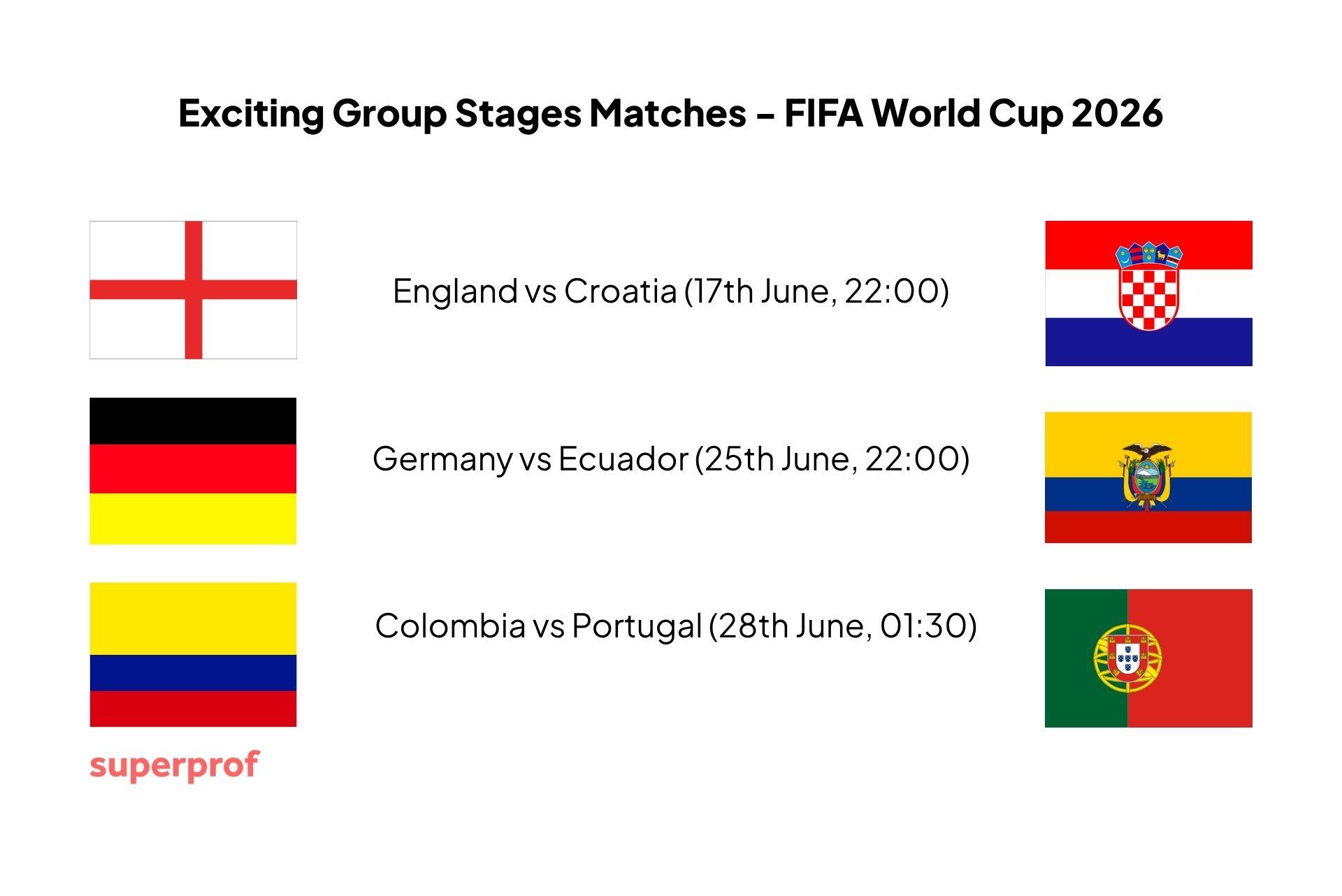
| 25 Jun | Ecuador 🇪🇨 vs Germany 🇩🇪 | 15:00 EDT | 22:00 | MetLife Stadium, New Jersey |
| 26 Jun | Curaçao 🇨🇼 vs Ivory Coast 🇨🇮 | 15:00 EDT | 21:00 | Lincoln Financial, Philadelphia |
Group F
| Date | Match | Host City Time | SAST (SA) | Stadium |
|---|---|---|---|---|
| 14 Jun | Netherlands 🇳🇱 vs Japan 🇯🇵 | 15:00 CDT | 22:00 | NRG Stadium, Houston |
| 14 Jun | Sweden 🇸🇪 vs Tunisia 🇹🇳 | 21:00 CDT | 04:00 (15 Jun) | AT&T Stadium, Dallas |
| 20 Jun | Netherlands 🇳🇱 vs Sweden 🇸🇪 | 12:00 CDT | 19:00 | NRG Stadium, Houston |
| 20 Jun | Tunisia 🇹🇳 vs Japan 🇯🇵 | 23:00 CDT | 06:00 (21 Jun) | Estadio Monterrey |
| 25 Jun | Japan 🇯🇵 vs Sweden 🇸🇪 | 18:00 CDT | 01:00 (26 Jun) | AT&T Stadium, Dallas |
| 25 Jun | Tunisia 🇹🇳 vs Netherlands 🇳🇱 | 18:00 CDT | 01:00 (26 Jun) | Arrowhead Stadium, Kansas City |
Group G
| Date | Match | Host City Time | SAST (SA) | Stadium |
|---|---|---|---|---|
| 15 Jun | Belgium 🇧🇪 vs Egypt 🇪🇬 | 12:00 PDT | 21:00 | Lumen Field, Seattle |
| 15 Jun | Iran 🇮🇷 vs New Zealand 🇳🇿 | 18:00 PDT | 03:00 (16 Jun) | SoFi Stadium, Los Angeles |
| 21 Jun | Belgium 🇧🇪 vs Iran 🇮🇷 | 12:00 PDT | 21:00 | SoFi Stadium, Los Angeles |
| 21 Jun | New Zealand 🇳🇿 vs Egypt 🇪🇬 | 21:00 PDT | 06:00 (22 Jun) | BC Place, Vancouver |
| 26 Jun | Egypt 🇪🇬 vs Iran 🇮🇷 | 20:00 PDT | 05:00 (27 Jun) | Lumen Field, Seattle |
| 26 Jun | New Zealand 🇳🇿 vs Belgium 🇧🇪 | 23:00 PDT | 08:00 (27 Jun) | BC Place, Vancouver |
Group H
| Date | Match | Host City Time | SAST (SA) | Stadium |
|---|---|---|---|---|
| 15 Jun | Spain 🇪🇸 vs Cape Verde 🇨🇻 | 12:00 EDT | 18:00 | Mercedes-Benz Stadium, Atlanta |
| 15 Jun | Saudi Arabia 🇸🇦 vs Uruguay 🇺🇾 | 18:00 EDT | 00:00 (16 Jun) | Hard Rock Stadium, Miami |
| 21 Jun | Spain 🇪🇸 vs Saudi Arabia 🇸🇦 | 12:00 EDT | 18:00 | Mercedes-Benz Stadium, Atlanta |
| 21 Jun | Uruguay 🇺🇾 vs Cape Verde 🇨🇻 | 18:00 EDT | 00:00 (22 Jun) | Hard Rock Stadium, Miami |
| 26 Jun | Cape Verde 🇨🇻 vs Saudi Arabia 🇸🇦 | 19:00 CDT | 02:00 (27 Jun) | NRG Stadium, Houston |
| 26 Jun | Uruguay 🇺🇾 vs Spain 🇪🇸 | 20:00 CST | 02:00 (27 Jun) | Estadio Guadalajara |
Group I
| Date | Match | Host CityTime | SAST (SA) | Stadium |
|---|---|---|---|---|
| 16 Jun | France 🇫🇷 vs Senegal 🇸🇳 | 15:00 EDT | 21:00 | MetLife Stadium, New Jersey |
| 16 Jun | Iraq 🇮🇶 vs Norway 🇳🇴 | 18:00 EDT | 00:00 (17 Jun) | Fenway Park Stadium, Boston |
| 22 Jun | France 🇫🇷 vs Iraq 🇮🇶 | 17:00 EDT | 23:00 | Lincoln Financial, Philadelphia |
| 22 Jun | Norway 🇳🇴 vs Senegal 🇸🇳 | 20:00 EDT | 02:00 (23 Jun) | MetLife Stadium, New Jersey |
| 26 Jun | Norway 🇳🇴 vs France 🇫🇷 | 15:00 EDT | 21:00 | Fenway Park Stadium, Boston |
| 26 Jun | Senegal 🇸🇳 vs Iraq 🇮🇶 | 15:00 EDT | 21:00 | BMO Field, Toronto |
Group J
| Date | Match | Host City Time | SAST (SA) | Stadium |
|---|---|---|---|---|
| 16 Jun | Argentina 🇦🇷 vs Algeria 🇩🇿 | 17:00 CDT | 03:00 (17 Jun) | Arrowhead Stadium, Kansas City |
| 16 Jun | Austria 🇦🇹 vs Jordan 🇯🇴 | 21:00 PDT | 06:00 (17 Jun) | Levi's Stadium, San Francisco |
| 22 Jun | Argentina 🇦🇷 vs Austria 🇦🇹 | 12:00 CDT | 19:00 | AT&T Stadium, Dallas |
| 22 Jun | Jordan 🇯🇴 vs Algeria 🇩🇿 | 20:00 PDT | 05:00 (23 Jun) | Levi's Stadium, San Francisco |
| 27 Jun | Algeria 🇩🇿 vs Austria 🇦🇹 | 18:00 CDT | 04:00 (28 Jun) | Arrowhead Stadium, Kansas City |
| 27 Jun | Jordan 🇯🇴 vs Argentina 🇦🇷 | 18:00 CDT | 04:00 (28 Jun) | AT&T Stadium, Dallas |
Group K
| Date | Match | Host City Time | SAST (SA) | Stadium |
|---|---|---|---|---|
| 17 Jun | Portugal 🇵🇹 vs DR Congo 🇨🇩 | 12:00 CDT | 19:00 | NRG Stadium, Houston |
| 17 Jun | Uzbekistan 🇺🇿 vs Colombia 🇨🇴 | 21:00 CDT | 04:00 (18 Jun) | Estadio Azteca, Mexico City |
| 23 Jun | Portugal 🇵🇹 vs Uzbekistan 🇺🇿 | 14:00 CDT | 21:00 | NRG Stadium, Houston |
| 23 Jun | Colombia 🇨🇴 vs DR Congo 🇨🇩 | 21:00 PDT | 04:00 (24 Jun) | Levi's Stadium, San Francisco |
| 27 Jun | Colombia 🇨🇴 vs Portugal 🇵🇹 | 15:00 EDT | 01:30 (28 Jun) | Hard Rock Stadium, Miami |
| 27 Jun | DR Congo 🇨🇩 vs Uzbekistan 🇺🇿 | 15:00 EDT | 01:30 (28 Jun) | Mercedes-Benz Stadium, Atlanta |
Group L
| Date | Match | Host City Time | SAST (SA) | Stadium |
|---|---|---|---|---|
| 17 Jun | England 🏴 vs Croatia 🇭🇷 | 15:00 CDT | 22:00 | AT&T Stadium, Dallas |
| 17 Jun | Ghana 🇬🇭 vs Panama 🇵🇦 | 19:00 EDT | 01:00 (18 Jun) | BMO Field, Toronto |
| 23 Jun | England 🏴 vs Ghana 🇬🇭 | 16:00 EDT | 22:00 | Gillette Stadium, Boston |
| 23 Jun | Panama 🇵🇦 vs Croatia 🇭🇷 | 19:00 EDT | 01:00 (24 Jun) | BMO Field, Toronto |
| 27 Jun | Panama 🇵🇦 vs England 🏴 | 20:00 EDT | 02:00 (28 Jun) | MetLife Stadium, New Jersey |
| 27 Jun | Croatia 🇭🇷 vs Ghana 🇬🇭 | 20:00 EDT | 02:00 (28 Jun) | Lincoln Financial, Philadelphia |
Don't see your timezone? FIFA Scores & Fixtures lets you select your territory and view the schedule in your local time.
Although much of the excitement and the highlights of the tournament are usually reserved for the knockout stage of the competition, this year, there are a lot of group stage matches to look forward to. Here are some examples:
For SA Fans: Your Complete Guide to Watching the 2026 World Cup
Whether you're planning to be in the stands or watching every match from your living room, this section breaks down everything you need to know to follow the action - from buying tickets and crossing borders to finding the right channel on game day.
How to Watch in a Stadium
🎟️ Getting Your Tickets
All official ticket sales happen exclusively through FIFA.com/tickets. You'll need a FIFA.com account to purchase, and every ticket is linked to the buyer's identity - so there are no anonymous resales.
FIFA has rolled out several sales phases since late 2025, all of which are now closed:
The early rounds
September 2025
Including the Visa Presale Draw
Early Ticket Draw
October 2025
Random Selection Draw
December 2025 – January 2026
The next and likely final window is the Last-Minute Sales Phase in April 2026, where remaining tickets go on sale first-come, first-served. If you haven't secured yours yet, this is your shot.
Prices vary hugely based on the match, stage and seating category. Note that all official prices are quoted in US dollars (USD). At the time of writing, $1,00 USD = approximately R16,54:
| Category | Description | Group Stage (USD) | Group Stage (approx. R) | Final Cat 1 (USD) |
|---|---|---|---|---|
| Category 1 | Lower tier, closest to pitch | $120–$250 | ~R1 988,39 - R4 142,13 | Up to $6,730 (~R111 506,24) |
| Category 2 | Both tiers outside premium zone | $80–$150 | ~R1 325,52 - R2 485,36 | – |
| Category 3 | Mainly upper tier | $70–$100 | ~R1 159,83 - R1 656,75 | – |
| Category 4 | Most affordable, upper tier | From ~$60 | From ~R994,05 | – |
FIFA applies variable pricing, meaning costs may shift between sales phases depending on demand. The four categories break down as follows: Category 1 is closest to the pitch in the lower tier; Category 2 spans both tiers outside the premium zone; Category 3 sits mainly in the upper tier; and Category 4 offers the most affordable option, also in the upper tier.
Resale marketplaces like StubHub do list World Cup tickets, but these are not authenticated by FIFA, and prices may be above or below face value. The safest route remains the official FIFA platform.
🛬 Travel Tips: Visas, Borders and Getting Around
With matches spread across three countries, travel logistics matter more than at any previous World Cup.
❗ Here's what South African nationals should know before visiting Canada, the US and Mexico. ❗
🇨🇦 Entering Canada:
South Africans are not eligible for Canada’s eTA system, so a full visa application is required.
You will need to apply for a Temporary Resident Visa (visitor visa).
Key requirements:
- Valid passport
- Proof of funds
- Travel itinerary
- Biometrics (fingerprints and photo)
Processing times tend to stretch during peak demand, and the weeks before the tournament will be no exception. The Canadian government recommends flagging your FIFA attendance in your application.
🇺🇸 Entering the United States: South African passport holders are not eligible for the Visa Waiver Program (ESTA) and must apply for a B1/B2 tourist visa.
Key requirements:
- Valid passport
- Completed DS-160 application form
- Visa fee payment
- In-person interview at a US embassy/consulate
- Supporting documents (travel plans, finances, ties to SA)
Even with a match ticket, entry is not guaranteed, and visa approval is required in advance.
👉 FIFA and the U.S. State Department have introduced a “FIFA PASS” system that may help ticket holders get priority visa interview appointments, but it does not guarantee approval.
For fans who need a full B-2 tourist visa (rather than ESTA), FIFA and the US State Department have introduced FIFA PASS – a priority appointment scheduling system for ticket holders. This is the first time such a system has been offered at a World Cup. It does not guarantee a visa, but it significantly reduces waiting times. Access via the US Department of State website.
🇲🇽 Entering Mexico: South African passport holders generally require a visitor visa to enter Mexico.
However, you may enter visa-free (up to 180 days) if you hold:
- A valid multiple-entry visa from the US, UK, Canada, Japan, or Schengen area
or - Permanent residence in those countries
Otherwise, you must apply through a Mexican consulate.
Key things to keep in mind:
If you are following Bafana Bafana across multiple cities and crossing borders between the US, Canada and Mexico, keep the following points in mind:
- Each border crossing is treated as a separate immigration event, even if you have already entered one of the three host countries
- Carry your passport (valid for at least six months beyond 19 July 2026), your match tickets, proof of accommodation and evidence of sufficient funds
- A World Cup ticket is not an entry document, it demonstrates the purpose of travel but does not replace a visa
- Apply early because processing times stretch significantly in the weeks before the tournament
- Map out your visa requirements for each entry point well in advance if following your team through multiple cities
🤩 Alternatives to a Stadium Seat
You don't need to be in North America to feel the atmosphere. If you’re staying in South Africa, you’ll still have plenty of electric fan zones, pubs, and sports bars showing matches.
Here are the confirmed fan-zone locations across SA:
Cape Town
The following venues are known for screening major sporting events:
- Foresters Arms Restaurant & Bar – Historic pub with multiple screens and a strong sports atmosphere
- Mojo Market – Large venue with giant screens and space for big crowds
- Mitchell’s Scottish Ale House – Lively bar at the Waterfront popular for live sports
- Fireman’s Arms – Multiple TVs and projector screens for major matches
Johannesburg
Johannesburg has a wide range of sports bars, many offering big screens, drinks specials, and group seating for major tournaments. These are the top spots for match-day vibes:
- Benchwarmers -Classic sports bar with many TVs and a strong fan crowd
- 011 Gin-Eatery – Large screens and group-friendly seating
- Founders at Giles – Relaxed pub with multiple screens for live sports
Arrive early for big games because venues fill up fast.
Many bars operate on a first-come basis during major matches.
Expect a lively, social atmosphere, especially for knockout rounds.
How to Watch from Home
📺 Television and Streaming
Every one of the 104 games will be broadcast live. And there's good news for SA fans this time: The SABC has said that it will broadcast every match of the 2026 FIFA World Cup. You can also watch World Cup matches on the streaming platform, SportyTV.
Memorable Moments in World Cup History
The FIFA World Cup is the world's premier football tournament today, and one of the most-watched sporting events on the planet! But it wasn't always the universal and unifying competition that it is today, especially during the first two decades of competition. Here's a summary of the history of the World Cup:
The first editions of the World Cup (1930-1950)
The first World Cup took place in Uruguay in 1930. The champion of that edition was the host country itself: the Uruguayan national team, who beat Argentina in the final with a 4 x 2 score, in front of almost 90 000 people.
There were only 13 participating teams in the first World Cup: many European teams did not participate due to the long boat trip across the Atlantic Ocean. In 1934 and 1938, the tournament was held in Italy and France, respectively, and both editions were dominated by Italy. From then on, the tournament grew in popularity in Europe.
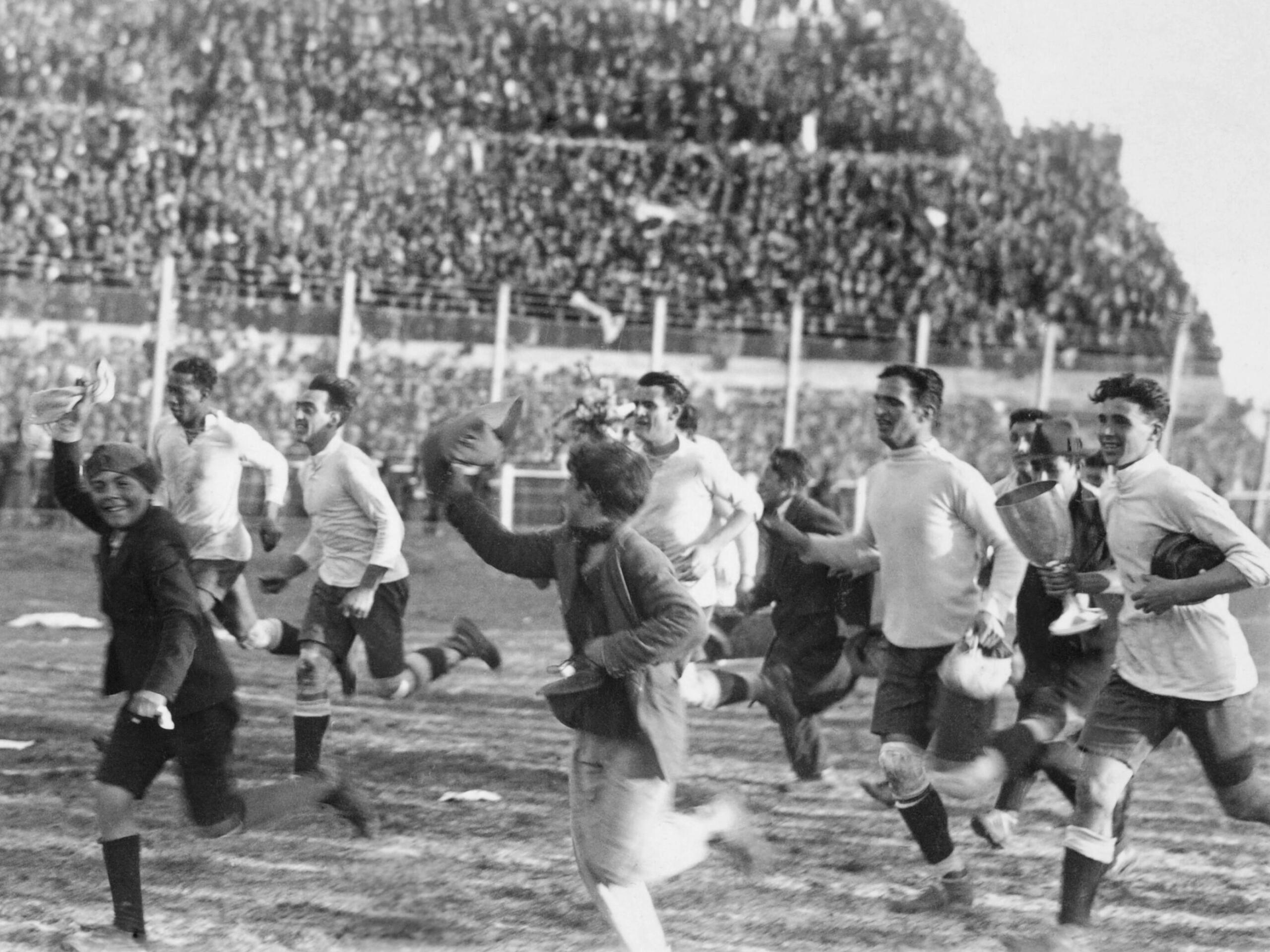
Between 1942 and 1946, the World Cup was interrupted due to World War II. In 1950, the competition returned, hosted by Brazil. The final was played at the famous Maracanã, with 200 000 people watching the home team lose to Uruguay (2-1), who won their second title. This is one of the largest crowds in football history, and undoubtedly one of the most memorable episodes in the FIFA World Cup.
1930
Uruguay
4-2 against Argentina (Montevideo, Uruguay)
1934
Italy
2-1 against Czechoslovakia (Rome, Italy)
1938
Italy
4-2 against Hungary (Paris, France)
1942
Not held (World War II)
-
1946
Not held (World War II)
-
1950
Uruguay
2-1 against Argentina (Rio de Janeiro, Brasil)
Golden Era and Dominance of the Brazilian National Team (1954-1970)
The 1954 FIFA World Cup took place in Switzerland, and Germany surprised everyone by winning its first title. Germany's victory became known as the "Miracle of Bern", as it was an unexpected triumph over the team most favoured to win the title match: the "unbeatable" Hungary. Furthermore, it was a symbol of hope for the German population after the Second World War.
In 1958 and 1962, the Brazilian national team won consecutive World Cup titles. At only 17 years old, "king" Pelé showed himself to the world in the 1958 edition, being the youngest to score a goal in the competition.
The World Cup is a very important way to measure the good players, and the great ones. It is a test of a great player.
Pelé
In 1966, the competition went back to Europe to be hosted by England. The home team ended up winning the title, defeating West Germany 4-2 in the final, allowing the players to celebrate their victory at home. This remains England's only World Cup title to date.
In 1970, Brazil won its third title, with the team being considered at the time the best in history. The final took place in Azteca Stadium (Mexico), and the final score was Brazil 4 x 1 Italy. Pelé was named FIFA's best player of the competition. This is considered to be the Golden Age of Brazilian football: at that time, the national team had won 3 out of the 4 last World Cups, led by the best player in the world.
The 1970 edition was the first one to be broadcast in colour, worldwide. This contributed to the popularity of Pelé and the Brazilian national team around the world, wowing the audience with their artistic style of play.
How do you think Brazil will do this time around? What do you think of the current squad? Leave us your opinion in the comments!
1954
West Germany
3-2 against Hungary (Bern, Switzerland)
1958
Brazil
5-2 against Sweden (Stockholm, Sweden)
1962
Brazil
3-1 against Czechoslovakia (Santiago, Chile)
1966
England
4-2 against West Germany (London, England)
1970
Brazil
4-1 against Italy (Mexico City, Mexico)
Emerging Powers in World Football (1974-1990)
In 1974, a certain Dutch player began to stand out considerably in the World Cup: Johan Cruyff. The biggest revelation of the tournament was undoubtedly the Dutch national team, but the team that lifted the trophy ended up being the host country: West Germany. The story repeated itself four years later, in 1978: this time, the home team, Argentina, would go on to win the title in the final against the Dutch team (once again).
In 1982, Italy would go on to win the tournament and become three-time champions, thanks to the contribution of Paolo Rossi, the standout player in 1982. He was the top scorer with 6 goals and FIFA's Best Player of the Year Award. In the 1986 edition of the FIFA World Cup, Diego Maradona was the absolutestar of the tournament. The Argentine national team won their second championship by beating West Germany with a score of 3-2.
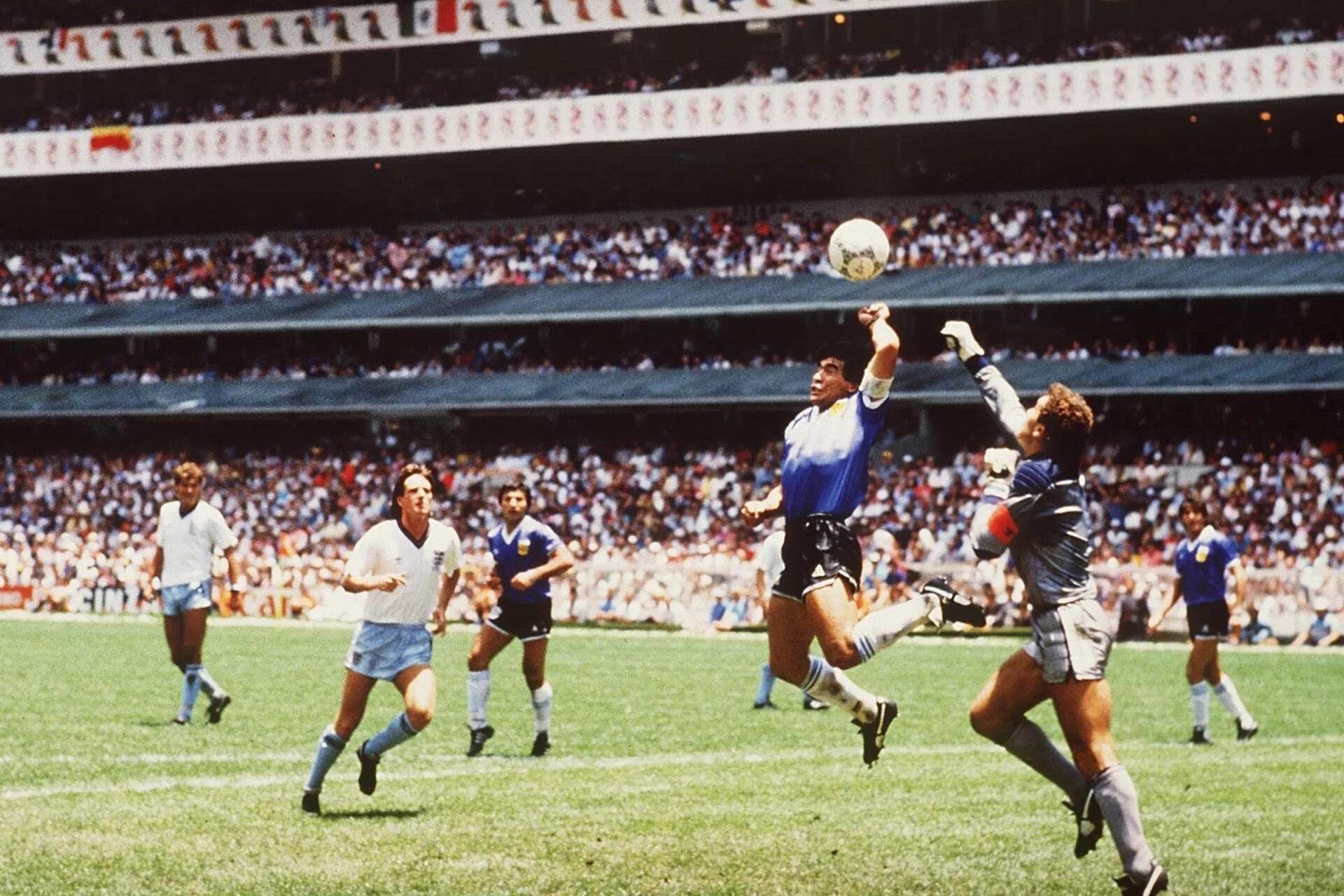
In 1990, West Germany would win their third World Cup title, with the tournament being hosted by Italy. The Germans beat Argentina 1-0 in the final, with a late penalty goal by Andreas Brehme.
1974
West Germany
2-1 against Netherlands (Munich, West Germany)
1978
Argentina
3-1 against Netherlands (Buenos Aires, Argentina)
1982
Italy
3-1 against West Germany (Madrid, Spain)
1986
Argentina
3-2 against West Germany (Mexico City, Mexico)
1990
West Germany
1-0 against Argentina (Rome, Italy)
Expansion of the FIFA World Cup (1994-2014)
In 1994, the tournament was held in the United States for the first time. However, the World Champion ended up being a familiar team: Brazil. This was the fourth World Cup title for the "Canarinha" - the star player was Romário, along with Bebeto.
The 1998 FIFA World Cup took place in France, and once again the Brazilian national team reached the final. However, this time the Brazilians were upset by the French team, playing at home in Stade de France, with Zinedine Zidane as a standout player. 1998 was the first edition of the World Cup with 32 participating teams.
But it didn't take long for Brazil to lift the trophy once again. In 2002, in a tournament held in South Korea and Japan, Brazil won their fifth World Cup title, beating Germany 2-0, with Ronaldo Nazário scoring both goals.
In 2006, the FIFA World Cup took place in Germany, with Italy becoming four-time champions. The Italians defeated France on penalties. In that game, Zidane famously headbutted an opposing player and was sent off, in front of 69 000 people in Berlin. In 2010, there was a first-time champion: the Spanish national team defeated the Netherlands in the final right here in Johannesburg.
Four years later, one of the most memorable moments in World Cup history took place. The Brazilian national team, playing at home, was one of the favourites to win the World Cup trophy. However, in the semifinal match, Brazil was eliminated in a devastating way by Germany by a score of 7-1, at the Mineirão Stadium, in Belo Horizonte. The German national team would go on to win the title, defeating Argentina in the final at the Maracanã stadium.
1994
Brazil
0-0 (3-1, penalties) against Italy (Pasadena, United States)
1998
France
3-0 against Brazil (Saint-Denis, France)
2002
Brazil
2-0 against Germany (Yokohama, Japan)
2006
Italy
1-1 (5-3 penalties) against France (Berlin, Germany)
2010
Spain
1-0 against Netherlands (Johannesburg, South Africa)
2014
Germany
1-0 against Argentina (Rio de Janeiro, Brazil)
Contemporary Era of the World Cup (2018-present)
In 2018, France won their second World Cup title, with a (young) Kylian Mbappé as a standout player. The competition was held in Russia for the first time. In the final, played in Moscow, the French team beat Croatia by a 4-2 score.
Later in 2022, the FIFA World Cup took place in Qatar: to avoid extreme temperatures, the event was held in November and December, becoming the first one to take place at the end of the year (instead of the traditional months of May, June, and July). The Argentinian national team ended up winning the title, with Argentinian player Lionel Messi as a star player.
2018
France
4-2 against Croatia (Moscow, Russia)
2022
Argentina
3-3 (4-2, penalties) against France (Lusail, Qatar)
2026
?
(New Jersey, United States)
This year, the FIFA World Cup will once again bring together the best national teams in the world – and consequently, the best players as well. Who do you think will win?
Records from the World Cup
The FIFA World Cup has been held every four years (almost continuously) since 1930. At almost a century old, the competition is full of records. Let's discover some of them!
- 🏅 All-time top scorer: Miroslav Klose (16 goals)
- 🏆 Player with the most titles: Pelé (3 titles)
- ⚽ Player with the most goals in a single edition: Just Fontaine (13 goals)
- 🏟️ Player with the most matches played: Lionel Messi 26 games
- 🏆 Country with the most titles: Brazil (5 titles)
- 🏟️ Biggest win in a semi-final: Germany 7 : Brazil 1
- ⚽ Most finals played: Germany (8 finals)
- 💚 Team with the most appearances: Brazil (all editions)
- 🧑 Largest game attendance: 1950 final at Maracanã (200 000 people)
- 🕛 Fastest goal: Hakan Sukur (11 seconds).
Place Your Bets: Who is Going to Win?
Based on current betting odds and analyst predictions, the favourites for the 2026 World Cup are the usual football powers, led by star players such as Mbappé, Yamal, Vinícius, Bellingham and legends like Messi and Ronaldo.
However, football is sometimes unpredictable and prone to surprises, especially when it comes to national teams. That said, which team do you think will win this year's tournament? Place your bet below! ⚽️
Which team will win the 2026 World Cup?
Your Soccer teacher is waiting on Superprof!
Ready to get started?
Discover our selection of experts and mentors!


Summarise with AI:
Enjoyed this article? Leave a rating!

 Loading...