

Whether Wimbledon has long been a summer TV staple or you're a tennis novice eager to start playing, understanding basic tennis rules should be your first step to enjoying the game. If you’re keen to get started with tennis lessons for beginners, learning the rules early will make every rally more enjoyable.
- The server must remain behind the baseline.
- Before serving, the server calls out the score.
- The receiver can stand anywhere but must avoid hitting the ball before it bounces, when possible.
- There's no set number of hits.
- Tennis scoring: 15 (1 point), 30 (2 points), 40 (3 points); 4 points secure victory.
- At 40-40, it's "deuce"; the game continues until a player earns a 2-point advantage.
- A handshake concludes the match.
If you have asked “what are the basic rules of tennis” or want to know about the tennis scoring system, then keep reading, this article is for you.







Tennis Origins
Despite its history, the rules of tennis are basically unchanged.
The origins of tennis are centuries old, with distinctions drawn between "real tennis" and the precursor to the modern game known as "lawn tennis." Real tennis, formerly called royal tennis, earned the name "the sport of kings" and was traditionally played indoors on lengthy asymmetrical courts with cork-cored balls encased in fabric tape.
Interestingly, even historical figures like Mary, Queen of Scots, indulged in tennis, even wearing men's clothing to be able to play more energetically.
Although the roots of the game stretch back nearly 19 centuries, remarkably, the fundamental rules of tennis have remained largely unchanged. Unlike many other sports, tennis has always maintained a degree of gender equality, not subjecting female players to distinct rules or exclusion from the sport.
Tennis history is to thank for the game’s enduring formality and etiquette. These historical intricacies contribute to tennis's enduring formality and severe penalties for rule violations, making it a sport marked by its strict adherence to regulations. Let's delve into their specifics to gain a deeper understanding of these rules.
Read the other article in our series if you're interested in learning about the benefits of tennis.
Beyond Your Tennis Ball and Racket
As important as it is to adhere to tennis rules and understand the tennis scoring system, you’ll need the right equipment. Tennis ball selection aside, good advice is to focus on your racket.
Tennis rackets can be made of graphite, aluminium, or even wood, but their dimensions are standardised. They must not exceed 29 inches in length, including the handle, and should not surpass 12.5 inches in width. The racket head's length should be limited to 15.5 inches, with a width cap of 11.25 inches.
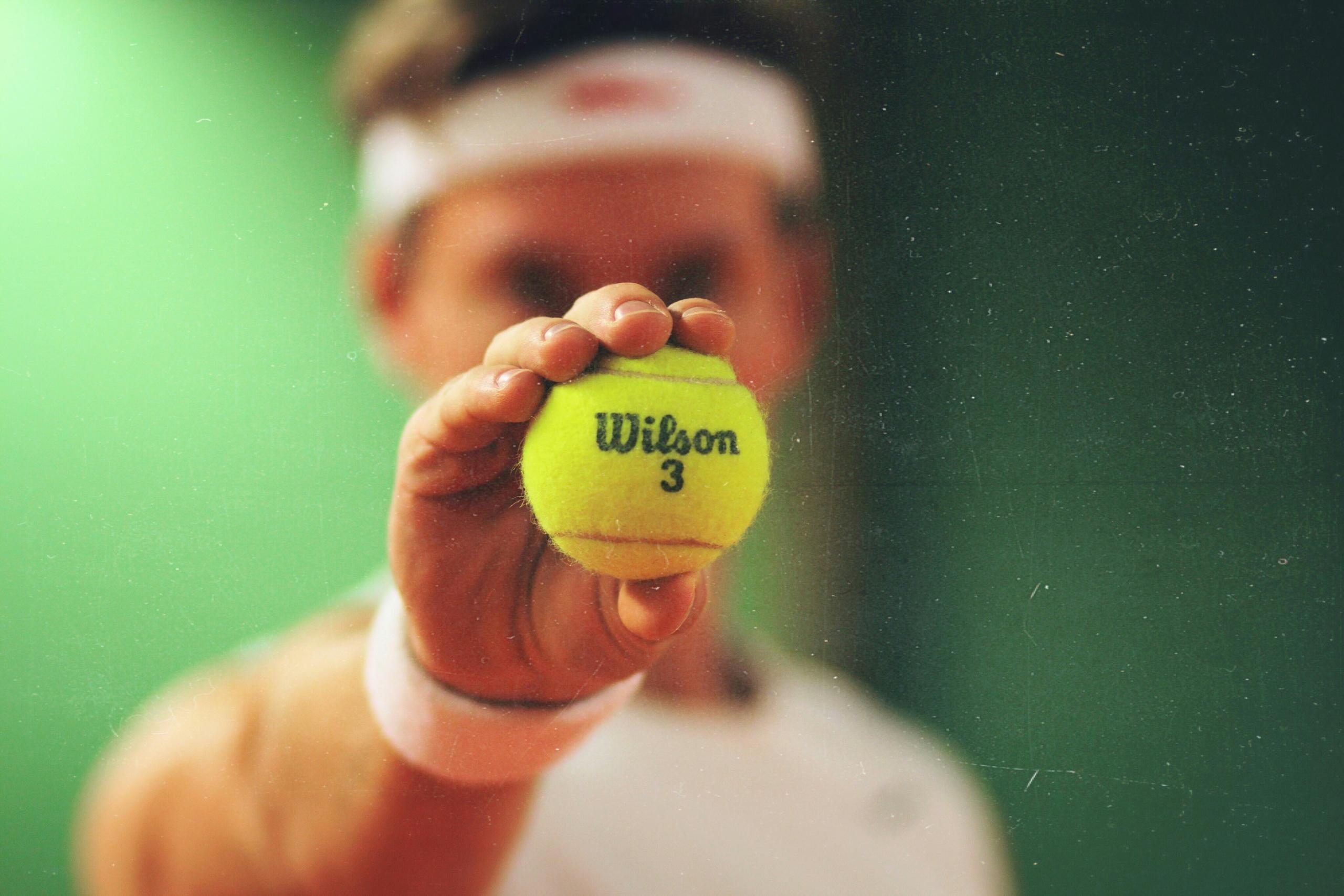
Your tennis ball choice will face less scrutiny, but it's worth knowing that tournament-approved balls have a diameter of between 2.5 and 2.63 inches, with a maximum weight of 60 grams.
Now, what are the basic rules tennis?
What are the Basic Rules of Tennis?
Tennis Rules for Serving
The key rule in tennis is to serve from behind the baseline to avoid a foot fault.
If you step on or cross any line, whether accidentally or deliberately, you will incur a penalty. Other foot faults include changing your court position, touching the court with your foot, or crossing extended sideline and centre lines.
Some lines are imaginary but can still lead to penalties if crossed. Opponents take turns to serve, game by game. Before serving, a moment of stillness is crucial. Any deviation may cost you a point. If the ball touches the net or your opponent isn't ready, it's a let, allowing a second serve. These rules are strictly enforced in tournaments but matter less in friendly matches.
Tennis Court Rules
You've surely noticed the lines that divide the centre-court into four sections, with the net bisecting the middle two.
If you're playing singles - you and your opponent, you will only play one half of the court, either to the right or the left of the centre line. However, if you're playing doubles, meaning you and a partner are playing against another pair, both sides of the court will be used.
So, if you're playing singles, you will stand on your chosen side of the centre line to serve and strive to hit on the diagonal, so that the ball flies across the centre line, to the side of the court your receiver is standing on.
Tennis Rules for Wheelchairs
Wheelchair tennis closely follows standard tennis rules with the primary distinction being the allowance for two bounces before hitting the ball. Wheelchair players can strike the ball after the first bounce if it's within the court boundaries, or after the second bounce regardless of its location. The players' wheelchairs are deemed an extension of their bodies, making it imperative to prevent the ball from touching the chair, akin to able-bodied players avoiding contact with their bodies. Wheelchair tennis competitors are also not allowed to encroach on the baseline while serving.
In matches against non-wheelchair opponents, the two-bounce rule is waived, and wheelchair athletes need to respect the standard one-bounce rule. Tennis scoring can be complex, adding to the intricacy of the sport.
The Tennis Scoring System
If you're new to tennis, the terminology like "love," "deuce," and "advantage" might initially seem perplexing. Compared to the straightforward scoring systems in many other sports, tennis scoring can appear complex, but with some familiarity it will become clear.
At the start of a game, both players have a score of "love," which is equivalent to zero in sports like soccer and hockey. Unlike those sports, tennis scores are announced before each serve.
When the server wins the first point, they call out "15-love," while if their opponent wins, it's "love-15." The player who wins the serve continues to serve throughout the game. As both sides earn points, the calls progress: "15-all" for two points each and "30-all" for a tie at two points each. If they reach three points each, it becomes "deuce," not "40-all."
Deuce is a pivotal point call in tennis. To win the game from a deuce, a player needs to score two additional points. This is where the concept of "advantage" (sometimes referred to as "ads") comes into play.
Imagine the server has an advantage (ad), meaning one more point will clinch the game. However, their opponent rallies and wins a point, causing the score to revert to deuce. Now, the competition intensifies to see who can secure the crucial two-point advantage to win the game.

A legendary match between Roger Federer and Andy Murray at the 2015 Wimbledon Men's semi-finals is an example of this kind of intense battle. After seven deuces, both players were exhausted.
Fortunately, their years of tennis experience allowed them to continue the match after a brief rest.
By now, you should be able to answer, what are the basic rules of tennis?
How to Play Sets in Tennis
Apart from the remarkable endurance of tennis superstars, like Serena Williams and Rafael Nadal, most players are content with the standard best-of-three set format.
In this system, the first player to reach 40 points plus one wins the set, and achieving this twice secures the match.
In tournament play, men's Grand Slam matches are best-of-five, while women's Grand Slam events follow the best-of-three structure. Doubles matches follow a best-of-three format with a 10-point tie-break instead of a full third set.
The key formula to remember is "game, set, match."
Each time a player serves, they start a game that continues as the ball travels over the net. A set is won by a player who secures six games while leading their opponent by a margin of two points. A standard match consists of three sets.
Finally, ability aside, the intricacies of tennis revolve around the tennis scoring system and sportsmanship. It is also good to remember that the rules of tennis rules are strict, and that you can lose points for minor mistakes, and this can prolong a match.
Ready to improve your tennis skills? If you're based in Gauteng, tennis lessons can also help you build confidence in match play.
The best advice we can give is for you to memorise the rules!
Summarise with AI:
Enjoyed this article? Leave a rating!

 Loading...