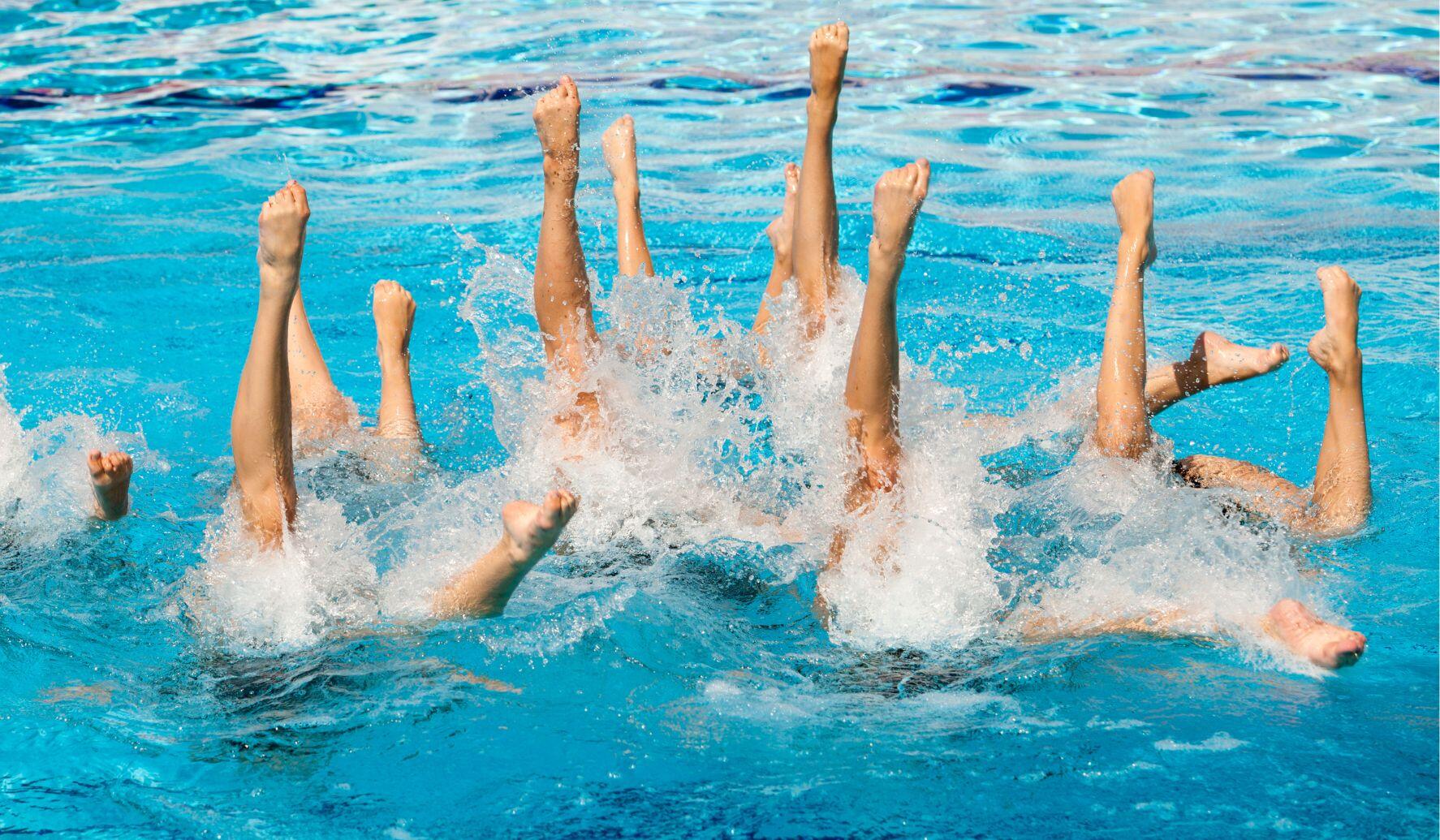

Do you want to dive into the captivating realm of synchronised swimming, also known as artistic swimming, where the perfect blend of incredible athleticism and breathtaking swimming styles take centre stage in the water?
Whether you're a dedicated enthusiast or a curious newcomer in search of synchronised swimming facts, this article provides a solid introduction to this mesmerising sport. We'll submerge into the rich history of synchronised swimming as well as its path to inclusion in the Olympics, and the unwavering commitment and meticulous training of synchronised swimming athletes.


What is Synchronised Swimming?
For many, swimming serves as an alternative means of traversing our surroundings, much like walking, running, or crawling. Yet, like any endeavour, delving deeper reveals varying degrees of expertise and intricacies to make it an even more fascinating study than it may, at first, seem.
Synchronised swimming draws inspiration from diverse art forms like dance and music, as well as various swimming styles, and offers both athletes and spectators an opportunity to discover the beauty of aquatic movement.
What's the difference between synchronised swimming and artistic swimming?
Nothing!
The World Aquatics body governs the sport, and formally changed its name from synchronised swimming to artistic swimming in 2017.
In essence, artistic swimming entails beautiful swimming styles and ballet-like movements to synchronised music.
Notably, synchronised swimming enjoys recognition as an Olympic sport, attracting athletes from around the world who practice and compete at the ultimate, international level.
What it Takes to Be a Synchronised Swimmer
There are a number of qualities to test the synchronised swimmer. Not only is there a high demand for physical ability and fitness, but there are a number of other attributes required to be a good, synchronised swimmer. Let’s take a look.
In a nutshell, synchronised or artistic swimming is a multifaceted discipline that demands athletes to continuously improve in various aspects for a chance at excellence. To relate it to other activities, it is safe to say that the synchronised swimmer must encompass the skills of both dancers and swimmers. This comparison isn't about one sport being superior to another but rather, highlights the depth and potential for growth within synchronised swimming.
Now, let's delve into the technical terminology and other synchronised swimming facts that help to form the foundations of the sport. We'll start by defining three primary categories of movements where the fundamentals of synchronised swimming routines harmonise.
To begin, first, grasp the notion of a "figure" in artistic swimming. A figure represents the specific motions executed by an individual swimmer to serve as the main elements on which the synchronised swimmer is individually assessed to determine their individual performance quality.
Transition: This encompasses the actions that link various segments of the routine seamlessly. These transitions may encompass notable alterations in the swimmer's posture, configuration, or figure. The assessment of performances centres on the fluidity and effectiveness of these transitions, as they serve to unify a sequence of disparate manoeuvres that culminate in a distinctive and harmonious presentation.
Pattern: The concept of "pattern" is a fundamental element in synchronised swimming, and it plays a crucial role in the sport's aesthetics and coordination.
Throw/Lift: Not unlike cheerleading, some of the most eagerly anticipated moments in synchronised swimming occur when the team suddenly elevates one of its members out of the water and performs acrobatic manoeuvres. This spectacle is marked by drama and excitement, and often takes the audience by surprise. In addition, it represents one of the more intricate feats to consistently execute.
Competitive Swimming and Synchronised Swimming Tournaments
Many synchronised swimmers aspire to more than simply reaping the health benefits and exercise that the sport offers. Instead, often the primary aim involves participating in competitions that showcase their skill and collaborative expertise.
Initially, participants are categorised into junior and senior divisions and then further organised into various tiers which are based on skill and proficiency. Within these age groups, further distinctions are made based on skill, with competitions falling into domestic, international, and master-level categories.
The evaluation of skill levels relies on a multifaceted grading system, consisting of three core components:
Figures Grades
Land Grades
Routine Grades
- Figures Grades: Much like evaluating swimming styles, these grades assess a swimmer's ability to independently execute individual movements and poses in the water, without the support of their team or any accompanying music. This evaluation is isolated from a routine and serves as a test of the individual's knowledge and personal skill level.
- Land Grades: Land grades gauge physical fitness and flexibility. Contrary to the aquatic setting, these assessments occur on dry land, providing coaches and judges with an up-close examination of the swimmer's athletic prowess. This phase allows for the refinement of intricate details that can make a significant difference in competition. Various skills are evaluated, including movement and coordination, core strength, gymnastic stability, speed and endurance, and even "explosive power."
- Routine Grades: Routine grades hold paramount importance as they measure performance by combining all the previously mentioned skills. During routine grading, a team collaboratively performs a routine, shifting the focus from individual athletic quality, which is evaluated in the other grading phases, to teamwork, coordination, and synchronicity. This grading system encompasses scores ranging from 1 to 5, with five denoting the highest level of difficulty. Each grade corresponds to a predetermined routine which eliminates the element of surprise on the day of the grading and allows athletes to practice and prepare accordingly.
If you're interested in other types of swimming, why not read our article on open water swimming?
A Roundup of Synchronised Swimming Facts
The journey, leading to the official recognition of synchronised swimming as a sport in 1941, and its subsequent inclusion in the Olympics during the 1960 Rome Games, was a lengthy one.
Synchronised swimming may have a deeper historical root than we currently understand. However, there are documented origins that can be traced back to the turn of the 20th century when artistic swimming styles emerged as a derivative of ballet. Initially, these swimming styles were often referred to as "water ballet," and the term "synchronised swimming" did not come into use until the sport gained greater recognition.
The inaugural competition of this "water ballet" occurred in 1891 in Berlin, however, it was only much later that terminology like synchronised swimming or synchronised swimmer was first coined at the "Century of Progress World Fair" in 1933 in Chicago. It was at this event, when the University of Chicago's water ballet club, under the leadership of Katherine Curtis, performed. Here, Curtis played a pivotal role in the history of synchronised swimming and contributed significantly to its eventual recognition as a sport. Later, her achievements were duly acknowledged in 1979 when she was inducted into the International Swimming Hall of Fame.
Shortly after its formal recognition as a sport, in 1960, synchronised swimming became a permanent fixture in the Olympic Games starting. Since then it has continued to be an integral part of the Olympics, with each competition showcasing increasingly impressive displays of aquatic coordination and swimming artistry.
As you can see, synchronised swimming has journeyed from its roots in water ballet to become a recognised and captivating Olympic sport. Its long, but steady, evolution reflects the artistry and dedication of swimming athletes like Katherine Curtis, and each Olympic showcase continues to highlight the mesmerising world of aquatic coordination and grace.
Summarise with AI
Enjoyed this article? Leave a rating!

 Loading...